Jujutsu: The Evolving Art
Part 1 – Introduction and Overview
By Tom Ross & Christopher Caile
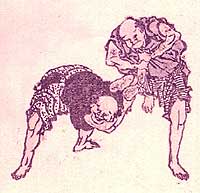
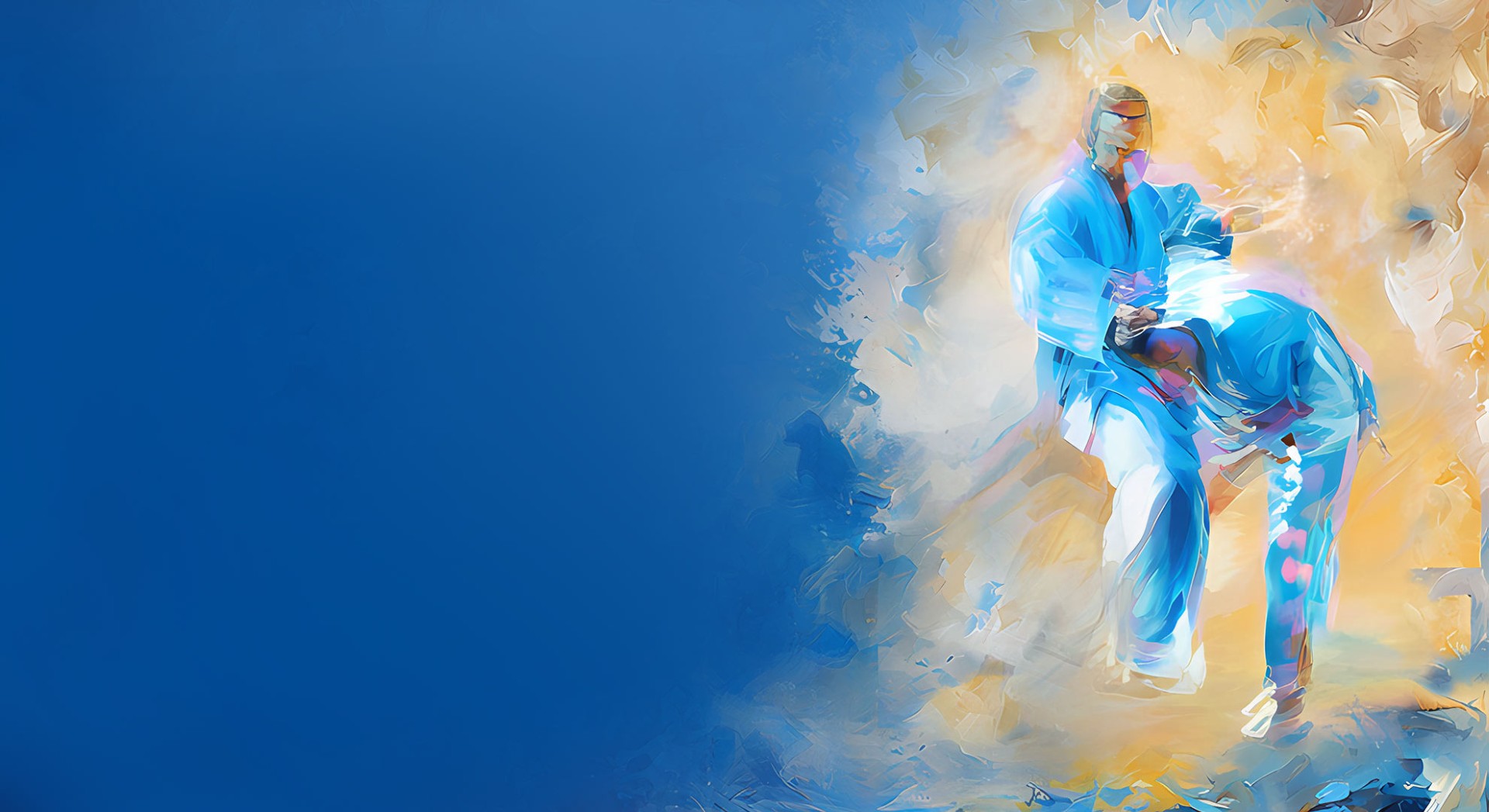
When most people hear the term jujutsu, they think of an empty handed method of self-defense whereby a tiny defender neatly dispatches much larger opponents, both unarmed and armed, with a series of deftly timed throwing techniques and chops to the body. While this picture is reminiscent of the Old Joe Jitsu cartoon character, it is a less than accurate portrayal of the arts this term represents.
In reality jujutsu doesn’t really describe a single combat method or specific art. Instead it is a general term referring to many Japanese systems of combat that have developed over the course history.
Jujustu systems also often included a variety of small weapons, such as a short knife, applied against unarmed or armed attackers. Jujutsu’s arsenal, depending on the method and style, included a wide variety of arm manipulations and joint locks, striking, kicking, kneeing, throwing, tripping, and incapacitation techniques. Eventually more than 750 schools of jujutsu were officially documented in Japan each usually stressed several of these specialties.
In China and elsewhere parallel systems also developed and were incorporated into many fighting systems. Today the best known term for these is Chin na (art of seizing, joint manipulation and striking). Throughout Asia and elsewhere the roots of these type of techniques are as old as man’s need for self-defense. In Japan, however, jujutsu has evolved through several distinct stages .
During the long periods of Japanese internal warfare up until around 1600, jujutsu techniques were most often used as a useful adjunct to weapons systems, such as the sword. Later, after 1600, many jujutsu systems (under many names) developed separately to address the needs of empty hand self-defense. These systems were separate from the techniques still practiced as part of the military arts.
In the late 1800’s and early 20th Century, derivatives of earlier systems emerged, such as judo, aikido, and Brazilian jujutsu — whose primary focus was spiritual, ethical and personal development in addition to self-defense. Some of these have, in more modern times, evolved into competition (sports) forms.
The concept of “Ju”
With all this diversity, number and types of jujutsu of systems that existed or still exist, it helpful to understand their classification under the term jujitsu by looking at the term itself.
The Japanese have a method of writing known as Kanji. Kanji are characters (visual images if you prefer) and as such cannot be learned by merely hearing their pronunciation. They can often be pronounced in several ways depending on the context. Each has it own meaning and subtle shades of meaning and thus represents far more than simply sounds, as are found with letters of the alphabet. By combining the character pronounced “JU” (which means flexible, pliable, gentle, yielding) with the character pronounced “JUTSU” (which means technique, or art), we arrive with the word.
We therefore begin to see jujutsu as meaning “flexible technique”, “gentle art,” or “yielding technique,” amongst others. This is a “primary principle” found in a large number of Japanese martial systems which differ significantly not only in technique but appearance. But certainly it is not the only principle of these arts.
Jigoro Kano (the founder of judo which was derived from several earlier jujutsu systems), for example, noted that jujutsu was not an art strictly comprised of “yielding.” Kano would often say:
“The way of gaining victory over an opponent is not confined to gaining victory by giving way, sometimes an opponent takes hold of one’s wrist, how can someone possibly release himself without using SOME strength against his opponents? The same thing can be asked when one is seized around the shoulders from behind by an assailant. These are forms of direct attack.”
| Part 1 – | Introduction and Overview |
| Part 2 – | Adjunct To Classical Weapon Systems |
| Part 3 – | Unarmed Jujutsu Systems, Daito Ryu & Aikido |
| Part 4 – | Other Jujutsu Derivatives: Judo & Gracie Jujutsu |
Tom Ross
Tom Ross is a retired NYC Correction Officer who specialized in the Handling of Security Risk group prisoners. A Yudansha under Ashihara karate (current affiliation) and in Shorinjiryu Kenzenkai Karatedo (an Offshoot of the Shorinjiryu Kenkokan founded by Masayoshi Hisataka), he also spent six years studying Jujutsu (classical, modern and Brazilian). Possessing an avid interest in the history of martial arts and traditions he currently serves as the Research Coordinator for FightingArts.com as well as moderating its Martial Arts Talk forum. He additionally serves as the moderator of the Sabaki List (which is dedicated to various martial artists and full contact stylists) and is a member of the International Hoplology Society.
About the Author Christopher Caile
Screenshot
Christopher Caile is the Founder and Editor-In-Chief of FightingArts.com. He has been a student of the martial arts for over 65 years.
He first started in judo while in college. Then he added karate as a student of Phil Koeppel in 1959 studying Kempo and Wado-Ryu karate. He later added Shotokan Karate where he was promoted to brown belt and taught beginner classes. In 1960 while living in Finland, Caile introduced karate to that country and placed fourth in that nation’s first national judo tournament.
Wanting to further his karate studies, Caile then hitch hiked from Finland to Japan traveling through Scandinavia, Europe, North Africa, the Middle East and South and Southeast Asia — living on 25 cents a day and often sleeping outside.
Arriving in Japan (1962), Caile was introduced to Mas Oyama and his fledgling full contact Kyokushinkai Karate by Donn Draeger, the famous martial artist and historian. Donn also housed him with several other senior international judo practitioners. Donn became Caile’s martial arts mentor, coaching him in judo and introducing him to Shinto Muso-ryu under Takaji Shimizu.
Caile studied at Oyama’s honbu dojo and also at Kenji Kurosaki’s second Tokyo Kyokushinkai dojo. In his first day in class Oyama asked Caile to teach English to his chief instructor, Tadashi Nakamura. They have been friends ever since. Caile also participated in Oyama’s masterwork book, “This Is Karate.”
Caile left Japan with his black belt and designation as Branch Chief, the first in the US to have had extensive training in Japan directly under Oyama Sensei. As such, Oyama Sensei asked him to be his representative on visits to his US dojos to report on their status.
A little over a year later, Nakamura, Kusosaki and Akio Fujihira won an epic David vs. Goliath challenge match against Thailand’s professional Muay Thai Boxers in Bangkok, Thailand, thrusting Kyolushinkai and Nakamura into national prominence.
Back in the US Caile taught Kyokushinkai karate in Peoria, Il while in college and later in Washington, DC. while in graduate school. Durimg this time Shihan Nakamura had moved to New York City to head Kyokushinkai’s North American Operation.
In 1976 when Kaicho Tadashi Nakamura formed the World Seido Karate organization, Caile followed. Living then in Buffalo, NY, Caile taught Seido karate and self-defense at the State University of New York at Buffalo (SUNY Buffalo) for over 15 years where he also frequently lectured on martial arts and Zen in courses on Japanese culture.
Caile moved to New York City in 1999 to marry Jackie Veit. He is now an 8th degree black belt, Hanshi, training in Seido Karate’s Westchester, NY Johshin Honzan (Spiritual Center) dojo. In Seido Caile is known for his teaching of and seminars on kata applications. He also produced a 14 segment video series on Pinan kata Bunkai currently available to Seido members.
Caile is also a long-time student and Shihan in Aikido. He studied in Buffalo, under Mike Hawley Shihan, and then under Wadokai Aikido’s founder, the late Roy Suenaka (uchi deshi under Morihei Ueshiba, founder of Aikido and was Shihan under Tohei Sensei). In karate, Suenaka (8thdan) was also an in-house student of the Okinawan karate master Hohan Soken.
Having moved to New York City, Caile in 2000 founded this martial arts educational website, FightingArts.com. Twenty-five years later, in 2025, it underwent a major update and revision.
For FightingArts.com and other publications Caile wrote hundreds of articles on karate, martial arts, Japanese art, Chinese Medicine and edited a book on Zen. He also developed relationships with a cross section of leading martial arts teachers. Over the last four decades he has conducted extensive private research into karate and martial arts including private translations of the once secret Okinawan hand copied and passed on Kung Fu book, the Bubishi, as well as an early karate book by the karate master Kenwa Mabuni. He periodically returns to Japan and Okinawa to continue his studies and participate Seido karate events. In Tokyo he practiced (with Roy Suenaka Sensei) in a variety of aikido organizations with their founders – including private interviews and practices at the Aiki-kai Aikido Honbu dojo with the son and grandson of aikido’s founder, Doshu (headmaster) Kisshomaru (an old uchi-deshi friend) and his son, Moriteru Ueshiba and in Iwama with Morihiro Saito. On Okinawa he studied Goju Ryu karate under Eiichi Miyazato, 10th dan founder of Naha’s Jundokan, and also with Yoshitaka Taira (who later formed his own organization, who specialized in kata Bunkai. While there Caile also trained with Hohan Soken’s senior student, Master Fusei Kise, 10 dan as well as with the grandson of the legendary karate master Anko Itosu.
Caile’s other martial arts experience includes: Diato-ryu Aikijujitsu and Kenjitsu, kobudo, boxing, Muay Thai, MMA, Kali (empty hand, knife and bolo), study of old Okinawan Shoran-ryu & Tomari body mechanics, study of old Okinawan kata under Richard Kim, study of close quarter defense and combat, including knife and gun defenses, Kyusho Jitsu and several Chinese fighting arts including 8 Star Praying Mantis, Pak Mei (White Eyebrow), and a private family system of Kung Fu.
Caile is also a student of Zen as well as a long-term student of one branch of Traditional Chinese Medicine, Chi Kung (Qigong). As one of two senior disciples of Chi Kung master Dr. Shen (M.D., Ph.D.) Caile was certified to teach and practice. This led to Caile’s founding of the The Chi Kung Healing Institute on Grand Island, NY. In Western NY, he also frequently held Chi Kung seminars, including at SUNY Buffalo and at the famous Chautauqua Institution in Chautauqua, NY. His articles on Chi Kung also appeared in the Holistic Health Journal and in several books on alternative medicine.
Caile holds a BA in International Studies from Bradley University and MA in International Relations with a specialty in South and Southeast Asia from American University in Washington, D.C. While in Buffalo, NY he also studied digital and analog electronics.
In his professional life Caile also worked in public relations and as a newspaper reporter and photographer. Earlier he worked in the field of telecommunications including Managing a Buffalo, NY sales and service branch for ITT. He then founded his own private telephone company. This was followed by creation of an electrical engineering company that designed and patented his concept for a new type of low-cost small business telephone system (which was eventually sold to Bell South). The company also did contract work for Kodak and the US space program. Simultaneously Caile designed and manufactured a unique break-apart portable pontoon boat.
Most recently Caile co-founded an internet software company. Its products include software suites with AI capability for control and management of streaming media, such as video and music, an all-in-one book publishing software product for hardcover, eBook and audio book creation and security software for buildings and government use.
For more details about Christopher Caile’s martial arts, work experience and life profile, see the About section in the footer of this site.
Search for more articles by this author: