Fighting Back At 40,000 Feet:
Part 3 – Weapons, Shields and Artillery
By Christopher Caile
Editor’s Note: Part 1 of this series discussed the possible eventuality of a terrorist takeover of an airplane, and the dilemmas of choice and morality that such an event would present to passengers. In Part 2, I examined some of the group strategies and individual tactics and methods that could be used to fight back. Here, I address weapons, shields and other items available to you in such emergencies.
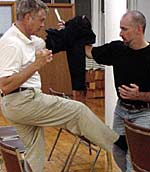
Defending against an attack, aided by a suit coat rolled around him forearm as a shield, this passenger strikes back with a low, bottom of the foot stomp kick to the attacker’s knee.
Airborne terrorist often depend on weapons. Knives, box cutters and other bladed or sharp pointed weapons, guns are intimidating. They know this and use the fear against you. They depend on you feeling helpless and not knowing what to do. Even worse, they may take hostages and if you get in their way, watch out. They’re ruthless.
But you aren’t defenseless. You can use everyday items as weapons, shields or spears: your laptop computer, cell phone, wallet, briefcase and many other items to create your own arsenal. You simply have to recognize what can be used and how. These items will not guarantee your success, but better armed than naked against fanatical armed assailants.
But don’t wait. Think about this topic now, because if you wait until the last second, until you are faced with actually doing something, it may be too late — you may not be able to think clearly, or you may miss items that could save your life.
Instant Help: Shields
If a terrorist with a knife or other bladed weapon was near me and I had decided to spring into action (from the front), I might look for something I could use, quickly – some physical object to block or smother the weapon, or to cover and protect part of my body, such as my arm used to ward off an attack. If the shield is large enough (such as a seat cushion or carry on bag) it can be used to push or smother an attacker’s movement, or distract him until, hopefully other passengers intervene.
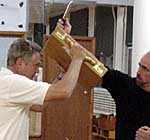
Holding a briefcase in front of you as a shield
Shields are everywhere. You can use a large pocket book, brief case, or carry on bag. One of the best barriers to use is a seat cushion from an unoccupied seat. Since these seat cushions are often designed to be used as a floatation device, they come loose easily and conveniently have handles or straps by which you can hold them. On “water equipped flights” (those over the ocean), however, life vests and other water safety items are found under the seats, and the seats themselves are not easily removable.
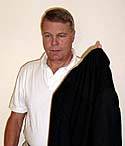
You can quickly improvise a shield to cover your forearm by wrapping a suit coat, jacket or overcoat around it. Start by grasping the inside of the collar.

Extend your left hand and pull the end of the coat toward you to start wrapping it around the forearm. A suit coat will normally wrap around the forearm twice, while a longer overcoat will go around three times.
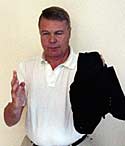
Hold your shielded arm in front of you. Be careful to keep the back of your arms turned outward so as to protect the more vulnerable inside.
Shoes can also be pushed over bare hands for protection from knife cuts. Overcoats, topcoats, jackets, blankets, sweaters or other items can be wound around your forearm to protect it from knife slashes or hits from hard objects. And don’t forget to use an injured or subdued terrorists himself who can be held up as a shield against his friends.
In most airline galleys there are also metal storage boxes affixed to the wall that have large square metal lids with handles. They can make excellent shields and might even be able to deflect or slow down a bullet. Their corners can also be used as weapons.
Barriers
Barriers are used to block movement by an assailant or to deny entry into an area by others. Most often it is a passenger, sometimes aided by a shield, who physically blocks an aisle or area with his body. This person can also use the threat of an improvised weapon, or use hard kicks (see Part 2) to intimidate and forestall movement or attack.
A disarmed, subjugated assailant can also be used as a human barrier to block movement of his friends. If a serving cart is accessible, however, it can also be used to help block an aisle or the path of an attacker.
Improvised Weapons (lances, clubs and maces)
Weapons are equally abundant around you. Look for heavy, hard or hard cornered objects, or things with points or that can be folded to make a point. These types of weapons have an advantage over you own natural weapons like your fist – they extend your range of attack. They can also be more threatening. Below, I have categorized various types of improvised weapons.
Weapon and Shield Combo: The corner or edge of any hard object, such as the corner of a computer or a semi-hard briefcase, book, or the edge of a metal galley container cover. The object can be used as a shield, but also pushed forward to strike an assailant’s neck or a corner can be thrust into an eye socket (see illustrations in Part 2).
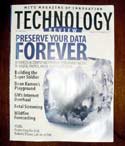
Turning a magazine into a spiked weapon is easy. Start with it flat.
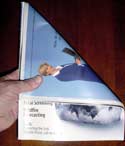
Fold one corner onward.
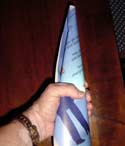
Fold the entire magazine again in the same direction.
Spiked Lances: A magazine can be folded to make a hard point along the ridge of its binding. A pen or pencil can be stuck in the fold of a wallet, a business card carrying case, soft cover book, or wrapped in a glove, or the pointed end of a spiked comb can be used to stab like an ice pick – into the eyes, neck or other soft areas of the body.
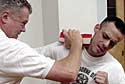
The end of tightly rolled paperback book is used to strike at an attacker’s throat.
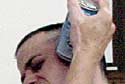
The hard edge of the end of a full soda can is used to strike an attacker’s temple.
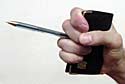
A pen stuck into the fold of a business card holder, wallet or paperback book can be held in the hand and used as a spiked weapon.
Clubs: Hard objects held in the hand, such as a camera, cell phone, CD-player, full can of soda, or a computer transformer. Even a paperback book can be used if it is rolled up tight in the hand. The striking surface is the tightly backed rolled end. In the airline bar cart or galleys there are also usually small bottles of wine that can be held in the hand, the end protruding, and used as a small club. In first class, once the flight is in the air there are also usually full sized bottles of champagne and wine sitting out on the counters of the first class galley for easy access. These make perfect clubs.
Mace-like Swung Items: A briefcase (if it has hard corners) can be swung at shoulder height (so not to hit the low cabin ceiling) to target the head (illustrated in Part 2) or neck or swung underneath and up into the groin. Heavy, hard objects can also be put in a sock, fanny pack or in a shirt and swung as an impact weapon like a mace used by European medieval knights (also illustrated in Part 2). Useful objects include a computer transformer, camera, full can of soda or any other small weighty object. The cover from an airline pillow can also sometimes be used to hold the object, but be sure it is cloth, not paper.
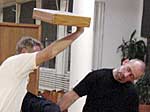
Here a briefcase is swung overhead like a mace into the head of an attacker. Because of the low ceiling, the arm is brought up first, but then pulled down as the briefcase swings forward.
Knives, Bladed Weapons and Guns: While these are not initially available to passengers, if an armed terrorist is subdued, his or her weapon becomes available.
Projectiles (personal artillery)
Projectiles are any items that can be thrown or projected into the face or path of an assailant to distract him, make him flinch, or to affect his eyesight momentarily. Their use provides a split second opportunity for other action.
Use pocket change (illustrated in Part 2) or other pocket items as keys. Don’t forget that any liquid in a cup, such as coffee, juice, soft drink or liquor, works well too. This includes spitting into someone’s face. You can also use about anything else you can pick up including a camera, full soda bottles, etc., but be careful not to hit other passengers. Thus these objects are best used before actual engagement, when you as an individual or a group of people are closing in.
Use of these items also presents a danger. They might be thrown back. More importantly, however, if the plane should suddenly lose height or shift position, loose items can become airborne missals that can hit and injure anyone in their path.
Smothering Items
These are items that can be thrown over the heads of attackers to blind their visions momentarily and confuse them and/or smother arm movement. Use of such objects usually include an effort to pin an assailant’s arm, tackle or otherwise restrain. Use overcoats, jackets, blankets or other large cloth objects. These have to be used at close range, however, and the height of the cabin often restricts movement.
Restraining Items
If you are able to overwhelm terrorists, follow-up restraint is necessary. A group of passengers can pile on a terrorist to neutralize him and hold him or her in place, but using some form of other restraint is preferable, especially if it is for a prolonged period of time. Some useful items for tying up an attacker include: belts, long shoe laces, headset cords (those provided by the airline and those from passenger CD-players and other electronic devices), and electric cords or telephone line cords from computers. Also look for lifelines, which are located over the wing exit doors. They are used to help passengers navigate across wings in the case of emergency exit, and are long and somewhat cumbersome. Additional restraint can also come from a seat belt that can help hold an assailant in a seat if he or she has been otherwise subdued or restrained.
While the above items do not comprise a full list, they should get you thinking. They just might help you, or even save your life, if you are ever confronted by the unlikely event of an onboard terrorist attempt to take over your airplane.
Disclaimer:
This article is for educational purposes only and does not represent advice, suggested action or activities that airline passengers should or could take. It represents the views of the author only, who is trained in self-defense and the use of weapons. The intent of this article is only to provoke thought. In the event of an actual airline incident the direction of airline flight crew, pilots and/or air marshals should be followed.

About the Author Christopher Caile
Screenshot
Christopher Caile is the Founder and Editor-In-Chief of FightingArts.com. He has been a student of the martial arts for over 65 years.
He first started in judo while in college. Then he added karate as a student of Phil Koeppel in 1959 studying Kempo and Wado-Ryu karate. He later added Shotokan Karate where he was promoted to brown belt and taught beginner classes. In 1960 while living in Finland, Caile introduced karate to that country and placed fourth in that nation’s first national judo tournament.
Wanting to further his karate studies, Caile then hitch hiked from Finland to Japan traveling through Scandinavia, Europe, North Africa, the Middle East and South and Southeast Asia — living on 25 cents a day and often sleeping outside.
Arriving in Japan (1962), Caile was introduced to Mas Oyama and his fledgling full contact Kyokushinkai Karate by Donn Draeger, the famous martial artist and historian. Donn also housed him with several other senior international judo practitioners. Donn became Caile’s martial arts mentor, coaching him in judo and introducing him to Shinto Muso-ryu under Takaji Shimizu.
Caile studied at Oyama’s honbu dojo and also at Kenji Kurosaki’s second Tokyo Kyokushinkai dojo. In his first day in class Oyama asked Caile to teach English to his chief instructor, Tadashi Nakamura. They have been friends ever since. Caile also participated in Oyama’s masterwork book, “This Is Karate.”
Caile left Japan with his black belt and designation as Branch Chief, the first in the US to have had extensive training in Japan directly under Oyama Sensei. As such, Oyama Sensei asked him to be his representative on visits to his US dojos to report on their status.
A little over a year later, Nakamura, Kusosaki and Akio Fujihira won an epic David vs. Goliath challenge match against Thailand’s professional Muay Thai Boxers in Bangkok, Thailand, thrusting Kyolushinkai and Nakamura into national prominence.
Back in the US Caile taught Kyokushinkai karate in Peoria, Il while in college and later in Washington, DC. while in graduate school. Durimg this time Shihan Nakamura had moved to New York City to head Kyokushinkai’s North American Operation.
In 1976 when Kaicho Tadashi Nakamura formed the World Seido Karate organization, Caile followed. Living then in Buffalo, NY, Caile taught Seido karate and self-defense at the State University of New York at Buffalo (SUNY Buffalo) for over 15 years where he also frequently lectured on martial arts and Zen in courses on Japanese culture.
Caile moved to New York City in 1999 to marry Jackie Veit. He is now an 8th degree black belt, Hanshi, training in Seido Karate’s Westchester, NY Johshin Honzan (Spiritual Center) dojo. In Seido Caile is known for his teaching of and seminars on kata applications. He also produced a 14 segment video series on Pinan kata Bunkai currently available to Seido members.
Caile is also a long-time student and Shihan in Aikido. He studied in Buffalo, under Mike Hawley Shihan, and then under Wadokai Aikido’s founder, the late Roy Suenaka (uchi deshi under Morihei Ueshiba, founder of Aikido and was Shihan under Tohei Sensei). In karate, Suenaka (8thdan) was also an in-house student of the Okinawan karate master Hohan Soken.
Having moved to New York City, Caile in 2000 founded this martial arts educational website, FightingArts.com. Twenty-five years later, in 2025, it underwent a major update and revision.
For FightingArts.com and other publications Caile wrote hundreds of articles on karate, martial arts, Japanese art, Chinese Medicine and edited a book on Zen. He also developed relationships with a cross section of leading martial arts teachers. Over the last four decades he has conducted extensive private research into karate and martial arts including private translations of the once secret Okinawan hand copied and passed on Kung Fu book, the Bubishi, as well as an early karate book by the karate master Kenwa Mabuni. He periodically returns to Japan and Okinawa to continue his studies and participate Seido karate events. In Tokyo he practiced (with Roy Suenaka Sensei) in a variety of aikido organizations with their founders – including private interviews and practices at the Aiki-kai Aikido Honbu dojo with the son and grandson of aikido’s founder, Doshu (headmaster) Kisshomaru (an old uchi-deshi friend) and his son, Moriteru Ueshiba and in Iwama with Morihiro Saito. On Okinawa he studied Goju Ryu karate under Eiichi Miyazato, 10th dan founder of Naha’s Jundokan, and also with Yoshitaka Taira (who later formed his own organization, who specialized in kata Bunkai. While there Caile also trained with Hohan Soken’s senior student, Master Fusei Kise, 10 dan as well as with the grandson of the legendary karate master Anko Itosu.
Caile’s other martial arts experience includes: Diato-ryu Aikijujitsu and Kenjitsu, kobudo, boxing, Muay Thai, MMA, Kali (empty hand, knife and bolo), study of old Okinawan Shoran-ryu & Tomari body mechanics, study of old Okinawan kata under Richard Kim, study of close quarter defense and combat, including knife and gun defenses, Kyusho Jitsu and several Chinese fighting arts including 8 Star Praying Mantis, Pak Mei (White Eyebrow), and a private family system of Kung Fu.
Caile is also a student of Zen as well as a long-term student of one branch of Traditional Chinese Medicine, Chi Kung (Qigong). As one of two senior disciples of Chi Kung master Dr. Shen (M.D., Ph.D.) Caile was certified to teach and practice. This led to Caile’s founding of the The Chi Kung Healing Institute on Grand Island, NY. In Western NY, he also frequently held Chi Kung seminars, including at SUNY Buffalo and at the famous Chautauqua Institution in Chautauqua, NY. His articles on Chi Kung also appeared in the Holistic Health Journal and in several books on alternative medicine.
Caile holds a BA in International Studies from Bradley University and MA in International Relations with a specialty in South and Southeast Asia from American University in Washington, D.C. While in Buffalo, NY he also studied digital and analog electronics.
In his professional life Caile also worked in public relations and as a newspaper reporter and photographer. Earlier he worked in the field of telecommunications including Managing a Buffalo, NY sales and service branch for ITT. He then founded his own private telephone company. This was followed by creation of an electrical engineering company that designed and patented his concept for a new type of low-cost small business telephone system (which was eventually sold to Bell South). The company also did contract work for Kodak and the US space program. Simultaneously Caile designed and manufactured a unique break-apart portable pontoon boat.
Most recently Caile co-founded an internet software company. Its products include software suites with AI capability for control and management of streaming media, such as video and music, an all-in-one book publishing software product for hardcover, eBook and audio book creation and security software for buildings and government use.
For more details about Christopher Caile’s martial arts, work experience and life profile, see the About section in the footer of this site.
Search for more articles by this author: