
Kata, Bunkai & Calligraphy
By George Donahue
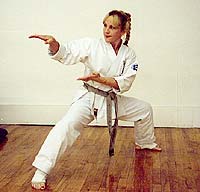 It has often been asked if applications should be practiced outside karate kata exactly as they are performed in the kata, or whether they should be modified to meet variations in the situation. Kata are sequential performances of prearranged techniques passed on from teacher to students. For centuries they have been a central teaching method of karate and they reveal not only function and application, but spirit and some say “secrets” as well. Thus, the question is an important one, since it affects the very heritage and understanding of karate itself.
Chotoku Omine-sensei (who was the head of Matsubayashi Ryu in the Americas) once told me that he regarded kata as the skeletal structure of karate. According to this generous and great Okinawan teacher (dead some twenty years now, unfortunately), kata practiced with strict dedication makes strong karate bones (mental, more than physical), but bones alone can’t do much. The art comes with how you refine and define the musculature that surrounds the skeleton and how you strengthen and refine the mind that moves the muscles that move the bones that you’ve made strong. We can regard kata as the optimal expression of a movement or technique, but we can also regard kata as the foundation from which the real expression of karate technique builds upward and outward and inward. Both points of view are constructive, but some moves in some of the kata are executed purposely from less than optimal circumstances.
Another teacher who has made a significant contribution to my development, Takayoshi Nagamine-sensei (who has succeeded his father, Shoshin Nagamine, as the head of Matsubayashi Ryu), told me that every kata is a riddle and that every visible move hides the truly important invisible or “hidden” move or application (called bunkai in Japanese). The kata that we see is the “me kata” (“me” is a Japanese word for “eye”) that occupies the eye while the real stuff goes on just below the level that we can register with our conscious mind. This teacher’s own teacher, Seigi Nakamura, with whom I studied for a short while, too, had rebuked him by saying that referring to a move as a “hidden” move makes it seem as though the moves are secret and are only given to the favored few, when actually they are there for everyone to see, if they’re willing to use their eyes in an unfettered manner. Nakamura-sensei preferred to call the “hidden” moves “intermediary” moves, because they occur between the obvious-to-the-eye basic moves, and because they are not exotic or special, but are just a little harder to catch. The key to catching them, by the way, is to watch the koshi (pelvic carriage) and hikite (pulling hand) carefully to penetrate the sleight of hand.
Yet another teacher, Katsuhiko Shinzato*, who has graciously served as a personal mentor, uses the well-known analogy of comparing kata to calligraphy, the art of writing kanji characters.
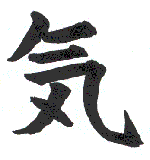 The first definable level on the continuum of kata performance is kaisho, or character printing in a somewhat stiff block style. Beginners do their kata this way, but so do advanced students when they’re teaching beginners or adhering to a standard of the ryu during group performances. Movements are angular, thick, and well defined. “Hidden” moves are hidden away for some other time or, in the case of beginners or the lazy, not yet discovered.
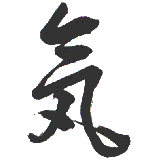 The next discrete level of performance is gyosho, or semicursive writing that is not as stiff and more flowing. This is cursive writing like it’s done by school kids. The individual letters (movements) are joined together with big loops and roundish patterns. The words are still very easy to read, but there is now room for the intermediary techniques, too. Individuality comes into play. Good black belts and exceptional brown belts perform their kata in this manner.
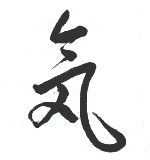 The highest discrete or definable level of performance is sosho (grass writing), or cursive writing which is free flowing and that allows freedom of physical and aesthetic expression. This is cursive writing as done by strong, mature individuals. You can make out the words still, but the words are accompanied by the poetry of the movement of the letters. The words should flow like ripples in the prairie grass on a windy day. The grass talks at these times, and so kata tells a story independent of and in addition to its components when done this way. Corners are cut, strokes may be dropped, but the flow is powerful. This is the level of performance of one who is truly a master of the kata. You might not perform all kata at this level, but usually mastery of any kata to this level means mastery of all kata to this level.
Of course, there’s always scribbling, and I’ve seen and done a lot of scribbled kata in my time.
Ultimately, we should be able to give birth to our techniques like a tree sways when the wind blows. Or when you scratch an itch — no thought.
Footnote:
* Shinzato-sensei subsequently wrote an article on this subject, which has appeared in a Japanese martial arts magazine and an adaptation of which is included in the “Big Blue” book of Shohei Ryu.]
Note: This article was edited by Wendy Hiester Gilbert (FightingArts Copy Editor), developed from material supplied by George Donahue that originally appeared as his answer to questions on the subject of kata that appeared on the Karate Cyber Dojo in May of 1997.
George Donahue
George has been on the board of FightingArts.com since its inception and is also a Contributing Editor.
George is a retired book editor, with a career spanning four decades, among his positions have been editorial stints at Random House; Tuttle Publishing, where he was the executive editor, martial arts editor, and Asian culture editor; and Lyons Press, where he was the senior acquisitions editor and where he established a martial arts publishing program. At Tuttle, he was the in-house editor for the Bruce Lee Library. Throughout his career he also edited, acquired, or reissued a wide array of military history, martial arts, and Asia-centric titles.
He was born in Japan in 1951 and originally named Fujita Tojo, with the Buddhist name KanZan. He was renamed George Donahue when he was several months old. After living part of his early childhood in the U.S. and France, he returned to Japan when he was seven years old and immediately was put (involuntarily) into intense training in traditional Japanese martial arts. His childhood training in Japan was focused on judo and jujutsu, primarily with Ando Shunnosuke, who blended keisatsujutsu (often referred to as police judo) and Olympic style judo in his teaching. He also studied kyujutsu (archery), sojutsu (spear), and kenjutsu (swordsmanship), with several teachers under the direction of his uncle, Tomita Yutaka. Following his return to the U.S. when he was twelve years old, he continued to practice judo and jujutsu, as well as marksmanship with Western style compound bow and firearms, and began the study of Matsubayashi Ryu karate in his late teens. Subsequently, he has studied aikido and cross trained in Ying Jow Pai kung fu. He began studying tai chi chuan in 1973 and now teaches qi gong and tai chi for health and fitness, as well as Okinawa Taijiken, which blends the principals of Okinawan karate with tai chi.
After studying Okinawa Karatedo Matsubayashi Ryu for ten years, he changed his focus to the teaching of Kishaba Chokei. He has been a student of Shinzato Katsuhiko, the director of Okinawa Karatedo Shorin Ryu Kishaba Juku, which comprises karate and kobujutsu (including Yamane Ryu Bojutsu) since 1983. He was also a student of Nagamine Shoshin, Nagamine Takayoshi, Kishaba Chokei, and Nakamura Seigi until their deaths. A key teacher in the U.S. was Arthur Ng, with whom he trained and taught for several years in New York City. He currently teaches Kishaba Juku privately, along with special training in karate, weapons, and self-defense. He has taught seminars throughout the U.S. and in Israel.
He has been teaching martial arts almost continually for sixty years. His first class, at twelve years old, was in judo for a group of military dependents and airmen at Sioux City Air Base, Iowa, at a time when the Air Force Strategic Air Command was beginning to stress training in martial arts, particularly jujutsu.
He was introduced to Kundalini Yoga practice in Japan but didn’t begin serious practice of Kundalini and Hatha Yoga until he was in college. He practices yoga at least an hour a day and now teaches various approaches to yoga. He is also a cancer exercise specialist and a Livestrong at the YMCA instructor, helping cancer survivors regain and maintain their vitality.
Search for more articles by this author: