
Koshi / Yao: An Introduction
By George Donahue
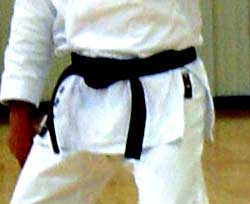
The Koshi area of the body
All good martial techniques arise from the koshi.
The most important component of any martial technique is the koshi, whether physical or psychological. To gain the optimum advantage from koshi use, we have to know exactly, or fully, what it is and how to develop and use it effectively.
The ideograph  is read in Chinese as yao and in Japanese as yo (easy to see that it derives from the Chinese) or koshi. In martial arts literature, koshi / yo is usually translated as “hips” and yao as “waist.” These translations are woefully incomplete and misleading, however. Because the ideograph is rather general, it can be used to mean a lot of related, but discrete things. It can also be easily mistranslated or misunderstood.
In the West, the seat of being is generally considered to be in the heart region. When we say something like “He lost heart and gave up,” we don’t mean that he had his cardiovascular system compromised and had to give up because he was dead or being kept alive on a ventilator, but that he lost his will. In most of Asia, the self is thought to reside lower in the abdomen, at the body’s center of gravity. Therefore, when a martial arts instructor says to put more koshi or yao in your technique, she might be saying to use your body’s center of gravity more efficiently or she might just be admonishing you to stop being such a (spineless) wimp. The confusion only begins there.
To give you an idea of the range of meaning of , here are a few examples from Japanese usage:
 yobu = pelvis, pelvic region, hips, loins, waist
 koshi o orosu = to sit down. (But in martial arts venues, this could also mean to lower your body’s center of gravity as you stand.
 koshi kakeru = to sit down
 koshitsuki = gait; posture
 koshi ga tsuyoi = firm character, strong morals. (But in martial arts venues, this could also describe good technique.)
 koshiyowa = lack of perseverance, lack of resolve. (But in martial arts venues, this could mean weak technique as well as weak spirit.)
 koshi ga yowai = weak, vacillating
 koshinuke = coward, cowardice
So what do we mean when we speak of using the (physical) koshi?
A good starting point is to avoid trying to translate the term into your native language. Any translation will inevitably lead to a limitation of our understanding. (That’s why it’s good to read any literature in the original language, even if you have to resort to the dictionary for every other word.) In this case, it’s best just to adopt the Japanese or Chinese term, gradually learning more about its meaning with experience. It helps to begin with a working understanding of koshi / yao as:
- the pelvic region, including the hips, the pelvic carriage, and the lower spine, comprising the five lumbar vertebrae, the sacrum, and the coccyx;
- the lower abdomen up to about the navel, including the waist;
- the upper thighs;
- the point within your lower abdomen that is your body’s center of gravity (this is not the same for everyone, as it depends on individual physique, or lack thereof); as well as
- all the muscle, fat, glands, loose change, miscellaneous soft tissue and other stuff in and around these parts.
When we refer to koshi / yao, we are almost always referring to ALL of the above. Usually, though, only one coin is involved.
In subsequent articles, we’ll discuss how to develop and use koshi / yao, which, for brevity, from this point I’ll just call koshi.
Copyright © 2010 George Donahue & FightingArts.com

George Donahue
George has been on the board of FightingArts.com since its inception and is also a Contributing Editor.
George is a retired book editor, with a career spanning four decades, among his positions have been editorial stints at Random House; Tuttle Publishing, where he was the executive editor, martial arts editor, and Asian culture editor; and Lyons Press, where he was the senior acquisitions editor and where he established a martial arts publishing program. At Tuttle, he was the in-house editor for the Bruce Lee Library. Throughout his career he also edited, acquired, or reissued a wide array of military history, martial arts, and Asia-centric titles.
He was born in Japan in 1951 and originally named Fujita Tojo, with the Buddhist name KanZan. He was renamed George Donahue when he was several months old. After living part of his early childhood in the U.S. and France, he returned to Japan when he was seven years old and immediately was put (involuntarily) into intense training in traditional Japanese martial arts. His childhood training in Japan was focused on judo and jujutsu, primarily with Ando Shunnosuke, who blended keisatsujutsu (often referred to as police judo) and Olympic style judo in his teaching. He also studied kyujutsu (archery), sojutsu (spear), and kenjutsu (swordsmanship), with several teachers under the direction of his uncle, Tomita Yutaka. Following his return to the U.S. when he was twelve years old, he continued to practice judo and jujutsu, as well as marksmanship with Western style compound bow and firearms, and began the study of Matsubayashi Ryu karate in his late teens. Subsequently, he has studied aikido and cross trained in Ying Jow Pai kung fu. He began studying tai chi chuan in 1973 and now teaches qi gong and tai chi for health and fitness, as well as Okinawa Taijiken, which blends the principals of Okinawan karate with tai chi.
After studying Okinawa Karatedo Matsubayashi Ryu for ten years, he changed his focus to the teaching of Kishaba Chokei. He has been a student of Shinzato Katsuhiko, the director of Okinawa Karatedo Shorin Ryu Kishaba Juku, which comprises karate and kobujutsu (including Yamane Ryu Bojutsu) since 1983. He was also a student of Nagamine Shoshin, Nagamine Takayoshi, Kishaba Chokei, and Nakamura Seigi until their deaths. A key teacher in the U.S. was Arthur Ng, with whom he trained and taught for several years in New York City. He currently teaches Kishaba Juku privately, along with special training in karate, weapons, and self-defense. He has taught seminars throughout the U.S. and in Israel.
He has been teaching martial arts almost continually for sixty years. His first class, at twelve years old, was in judo for a group of military dependents and airmen at Sioux City Air Base, Iowa, at a time when the Air Force Strategic Air Command was beginning to stress training in martial arts, particularly jujutsu.
He was introduced to Kundalini Yoga practice in Japan but didn’t begin serious practice of Kundalini and Hatha Yoga until he was in college. He practices yoga at least an hour a day and now teaches various approaches to yoga. He is also a cancer exercise specialist and a Livestrong at the YMCA instructor, helping cancer survivors regain and maintain their vitality.
Search for more articles by this author: