Bushido Taikai Report
by Deborah Klens-Bigman, Ph.D.
Editor’s Note: Cooperation and sharing of knowledge between various martial arts disciplines is a great educational opportunity, one that spurs interest and broadens the knowledge and appreciation of other arts. A taikia, or gathering of various schools of martial arts, is one of the best vehicles through which participants can experience other discipline through exhibitions, workshops and seminars. FightingArts.com hopes this report will prompt others to participate or organize similar events.
May 5th is Boys’ Day, a traditional holiday in Japan. This auspicious date was also the day of the 5th Annual Bushido Taikai, held in East Lansing, Michigan.(1) The event was sponsored by Shakunage Consulting, Inc., an organization devoted to promoting Japanese culture in the U.S. and abroad, and The United States Tamiya ryu Iaijutsu Michigan Dojo. Martial arts dojo from around the East Lansing area were invited to participate in a day of demonstrations, “mini-courses” and fellowship. In addition to area participants, I was invited to attend as a special guest from New York Budokai. The Taikai took place at the newly renovated Hannah Community Center in East Lansing.
The day began with an enbu (exhibition), with demonstrations by each participating dojo, followed by a brief lunch. In the afternoon the teachers were invited to give two short workshops, each one hour long, in their respective disciplines. Participants could be members of the various dojo or members of the general public. The idea was that everyone could take the opportunity to explore the rudiments of the different styles. There was no admission charge for the enbu, but mini-course participants were asked to pay $5.00 per hour to help offset the cost of renting the gymnasium.
 After a brief opening ceremony, Michael Alexanian Sensei and his students from the U.S. Tamiya ryu Iaijutsu Michigan Dojo led off the enbu. Tamiya ryu is a very old form of Japanese swordsmanship which can trace its lineage back to the end of the 16th century. Besides technique, the study of Tamiya ryu involves learning the Code of Bushido with regard to character: right decision, bravery, compassion, right action, sincerity, honor, and loyalty. Since my style of iaido, Muso Shinden ryu, is descended from Tamiya ryu, it is always a treat to see these kata performed.

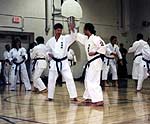

Next, we were treated to a demonstration by the Original Okinawa Karate Dojo, led by Seikichi Iha Hanshi, 10th dan, and assisted by Nakasone Sensei, 8th dan. This group teaches the Shido-kan style of Okinawan Shorin ryu Karate-do. The dojo is also the headquarters of the Beikoku (North American) Shido-kan Association. Iha Sensei brought a large group of students and showed a comprehensive overview of their curriculum, including kata and bunkai for various techniques. Nakasone Sensei then proceeded to break long one-by-three planks across the legs and arms of some of the students to show their toughness. This was definitely the crowd-pleasing highlight of the demo. The loudly cracking boards and flying splinters produced ample applause.
Next, we were treated to a demonstration by the Original Okinawa Karate Dojo, led by Seikichi Iha Hanshi, 10th dan, and assisted by Nakasone Sensei, 8th dan. This group teaches the Shido-kan style of Okinawan Shorin ryu Karate-do. The dojo is also the headquarters of the Beikoku (North American) Shido-kan Association. Iha Sensei brought a large group of students and showed a comprehensive overview of their curriculum, including kata and bunkai for various techniques. Nakasone Sensei then proceeded to break long one-by-three planks across the legs and arms of some of the students to show their toughness. This was definitely the crowd-pleasing highlight of the demo. The loudly cracking boards and flying splinters produced ample applause.
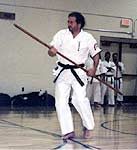 The Okinawan Karate-Do Club of Jackson, MI followed with a demonstration of Okinawan Kobudo Weapons forms. Chief Instructor Lee Norton explained how open-hand forms related to kobudo weapon forms, including the use of tsai and bo. The group also showed partner forms pitting different weapons against each other.
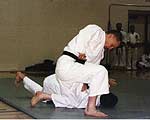

Next, Jerome Helton Sensei led a group of students from the Michigan State University Aikido Club in showing techniques and philosophy of Yoshokai Aikido. Helton Sensei did an excellent job of explaining various principles of harmony and utilizing the opponent’s energy as a means to self-defense, illustrating them with aikido techniques, including aikiken (aikido sword techniques).

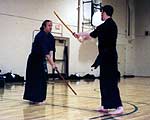
A kendo demonstration followed by Ron Fox Sensei of the MSU Kendo Club. Fox Sensei and one of his students showed some kendo no kata (formal partner techniques), followed by a brief demonstration of shiai, sparring in full kendo gear with bamboo shinai.
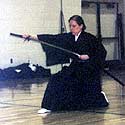
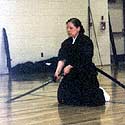
Last, but hopefully not least, I demonstrated some iaido techniques intended to outline the curriculum of New York Budokai. I showed forms from the Shoden, Chuden and Okuden levels of Muso Shinden ryu; then threw in a few from the Tenshinsho Jigen ryu style of iaido as well. Since I was alone, I was unable to show any kumidachi (partner techniques) which are also part of the curriculum. Maybe next year.
My demonstration ended both the morning and the enbu part of the Taikai. We were able to adjourn to the Shakunage Gardens and Culture Center for a brief but excellent lunch of zaru soba (cold buckwheat noodles) expertly created by Dianne Contos Alexanian, who also happens to be President of Shakunage Consulting.
In the afternoon, audience and dojo members were able to take part in mini-courses in Tamiya ryu iaijutsu, Okinawan Kobudo weapons forms, and Muso Shinden ryu iaido. Though each course was one hour, some participants elected to stay with the same art form for both sessions, while others circulated. This created a challenge for teachers who were not only introducing their art forms but trying to keep them interesting for the participants who stayed all afternoon.
The obvious question, of course, is what can be of interest to students who are trying out an art form for only a couple of hours, when it actually takes years to learn? Each teacher had his or her own approach. For my part, I tried to explain certain principles that apply broadly across disciplines, such as the use of koshi (hips/lower back) and in-yo (yin-yang), relate to the specific sword techniques that we teach. While it is extremely difficult to carry away specifics of an art form in such a short time, I think we were all hoping to impart a sense of shared interest to each other. Rather than the competitive spirit that exists at some taikai, the 5th Annual Bushido Taikai is designed to enhance understanding and cooperation. I hope I took some part in accomplishing that; and I hope to be able to participate again next year.
Footnote:
(1) The 2002 Bushido Taikai Participating Dojo were:
Karate
Iha Dojo (517) 482-3217
Shido-Kan Okinawan Karate
Iha Seikichi, Sensei
2018 East Michigan Ave.
Lansing, MI 48912
www.ihadojo.com
Okinawan Karate-do Club of Jackson (517) 768-1110
Okinawan Kobudo Weapons
Lee Norton, Sensei
137 ½ East Michigan Ave., 2nd Floor
Jackson, MI 49201
Kendo
MSU Kendo Club (517) 355-9672 Ext. 349
Ron Fox, Sensei
166A Cyclotron
Fox@msu.edu
www.msu.edu/~foxr/
Aikido
MSU Aikido Club (517) 393-3490
Ysohokai Aikido
C/O Shawn Twomey, Sensei
2924 Trapper’s Cove Trail #2b
Lansing, MI 48901
Iaido/Iaijutsu
United States Tamiya Ryu Iaijutsu (517) 332-3221
Michigan Dojo
Michael (Gennan) Alexanian, Sensei
838 Stuart Ave.
East Lansing, MI 48823
Info@Shakunage.org
www.shakunage.org/page.cfm
New York Budokai (212) 369-5797
Muso Shinden Ryu Iaido
Tenshoshin Jigen Ryu
Deborah Klens-Bigman, Sensei
info@newyorkbudokai.net
www.newyorkbudokai.net

Deborah Klens-Bigman Ph.D.
Deborah is a Jun Shihan (associate Master) of Shinto Hatakage Ryu Iai Heiho, a style of Japanese Swordsmanship.
She has also studied, to varying extents, kendo, jodo (staff), kyudo (archery) and naginata (halberd). She received her Ph.D in 1995 from New York University’s Department of Performance Studies where she wrote her dissertation on Japanese classical dance (Nihon Buyo).
Her article on the application of performance theory to Japanese martial arts appeared in the Journal of Asian Martial Arts in the summer of 1999, which has been translated into several other languages and reprinted several times. She has also been a frequent contributor to FightingArts.com.
Recently she relocated to beautiful West Virginia where she is continuing to practice jodo and iaido. She is married to artist Vernon Bigman and lives in a small house with a cat who really owns the place.
Search for more articles by this author: