Change The Altitude To Check Your Kata & Technique
By George Donahue
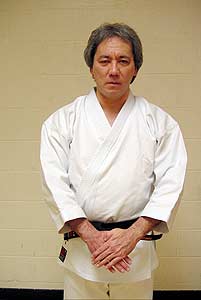
George Donahue practicing the ready position at the start of a kata.
Sometimes, a change in altitude can be better — far better — than a change in attitude.
Anyone who practices martial arts long enough will eventually have times when nothing seems to improve. We don’t gain understanding, we don’t get faster or stronger, we don’t get better in any way. If we stay stuck like this for too long we actually start to get worse, in many ways. If you get mired in this situation, and you train alone, you often just have to hope that you’ll pull through eventually. However, if you have a training partner or teacher to give you feedback, you can try the following method.
First, have your training partner lie on the floor to watch your kata or technique. The partner should begin by watching the space between the bottoms of your feet and the floor. The partner will notice immediately if you are wobbling or otherwise unbalanced, raising the heels, the toes, or the balls of the feet when they should be grounded or gripping the floor, or sliding when you should be staying put, and vice versa.
From that same vantage, your partner can then check to see whether your knees align properly with your feet and back — or if they’re wobbling. What’s “proper” differs with the technique, of course, but your partner should be able to pick this up easily. After the knees, the waist can be checked for alignment, too. The next thing your partner can check is to see whether your hips and shoulders dip when they should remain horizontal or remain even when one or more should be dipping or raising. Other faults, unfortunate habits, or outright mistakes might be visible, too.
Next, try having your partner observe the view from above. This can be done from stairs, a stepladder, or even by standing on a chair. You don’t need to be watched from a sitting or standing position, as that is the norm. From above, it’s easy to see whether the head is properly aligned with the shoulders and torso. It’s also easy to see whether you are toppling meekly into a stance or striding forcefully. This vantage is good, as well for watching the placement and snap of the attacking hand or leg, but it’s particularly good for watching the pulling hand and arm.
Copyright © 2011 George Donahue & FightingArts.com.
All rights reserved.

George Donahue
George has been on the board of FightingArts.com since its inception and is also a Contributing Editor.
George is a retired book editor, with a career spanning four decades, among his positions have been editorial stints at Random House; Tuttle Publishing, where he was the executive editor, martial arts editor, and Asian culture editor; and Lyons Press, where he was the senior acquisitions editor and where he established a martial arts publishing program. At Tuttle, he was the in-house editor for the Bruce Lee Library. Throughout his career he also edited, acquired, or reissued a wide array of military history, martial arts, and Asia-centric titles.
He was born in Japan in 1951 and originally named Fujita Tojo, with the Buddhist name KanZan. He was renamed George Donahue when he was several months old. After living part of his early childhood in the U.S. and France, he returned to Japan when he was seven years old and immediately was put (involuntarily) into intense training in traditional Japanese martial arts. His childhood training in Japan was focused on judo and jujutsu, primarily with Ando Shunnosuke, who blended keisatsujutsu (often referred to as police judo) and Olympic style judo in his teaching. He also studied kyujutsu (archery), sojutsu (spear), and kenjutsu (swordsmanship), with several teachers under the direction of his uncle, Tomita Yutaka. Following his return to the U.S. when he was twelve years old, he continued to practice judo and jujutsu, as well as marksmanship with Western style compound bow and firearms, and began the study of Matsubayashi Ryu karate in his late teens. Subsequently, he has studied aikido and cross trained in Ying Jow Pai kung fu. He began studying tai chi chuan in 1973 and now teaches qi gong and tai chi for health and fitness, as well as Okinawa Taijiken, which blends the principals of Okinawan karate with tai chi.
After studying Okinawa Karatedo Matsubayashi Ryu for ten years, he changed his focus to the teaching of Kishaba Chokei. He has been a student of Shinzato Katsuhiko, the director of Okinawa Karatedo Shorin Ryu Kishaba Juku, which comprises karate and kobujutsu (including Yamane Ryu Bojutsu) since 1983. He was also a student of Nagamine Shoshin, Nagamine Takayoshi, Kishaba Chokei, and Nakamura Seigi until their deaths. A key teacher in the U.S. was Arthur Ng, with whom he trained and taught for several years in New York City. He currently teaches Kishaba Juku privately, along with special training in karate, weapons, and self-defense. He has taught seminars throughout the U.S. and in Israel.
He has been teaching martial arts almost continually for sixty years. His first class, at twelve years old, was in judo for a group of military dependents and airmen at Sioux City Air Base, Iowa, at a time when the Air Force Strategic Air Command was beginning to stress training in martial arts, particularly jujutsu.
He was introduced to Kundalini Yoga practice in Japan but didn’t begin serious practice of Kundalini and Hatha Yoga until he was in college. He practices yoga at least an hour a day and now teaches various approaches to yoga. He is also a cancer exercise specialist and a Livestrong at the YMCA instructor, helping cancer survivors regain and maintain their vitality.
Search for more articles by this author: