Defeating A Knife To The Neck
By Christopher Caile
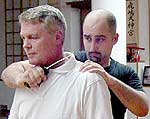 It’s very scary. Of all the possible attacks, having an assailant’s knife pressing against your throat evokes the worst fear and trepidation. And this is for good reason – it is a very dangerous situation, one in which you could die, or at least suffer a gory, bloody and life endangering wound.
If the intent is to rob you, gladly give up your money. But if someone is intent on causing you serious bodily harm, or intends to take you as a hostage, you might take action. Action is also warranted if you are a women and someone is using this tactic to force you into a van, truck or back of the car. In this type of rape or bodily assault situation statistics are dire for those who are so manhandled.
I wish there were a simple remedy, a fool proof escape that could be easily executed. There isn’t. There are lots of people who demonstrate self-defense techniques against this type of attack, but unfortunately many of them will just get you very dead. The reason is that what seems effective against a cooperative practice partner is often ineffective against a larger, stronger and determined attacker.
First, accept the fact that you might get cut. Also be aware that your technique could go wrong at any time. Thus, below we outline one effective technique, but also give roadmaps to several detours, just in case things happen that you don’t expect.
 |
 |
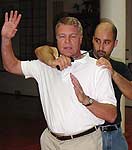
An attacker reaches around from behind and puts a knife to your throat (lead photo). Here, I do two things, one to increase my reaction time and the second to slow the attacker’s possible reaction to my defense. First, I partially raise my right arm (optional), while also raising my left towards the knife hand. To the aggressor this seems to be a gesture of capitulation. At the same time I start to say something not wholly comprehensible like “Ok, Ok, my wife needs..,” which occupies the attacker’s mind. An occupied mind slows his response time, and gives you a split second advantage.
While you are saying something, grab the knife hand with your left hand (notice the hand grabs across the wrist so I can get all my fingers around it) and roll the arm downward and keep it pinned to the chest (If you practice aikido or other jujutsu, see footnote (1) below). Also raise your right arm so your shoulder blocks the knife arm from moving across and cutting you. Also aim your fingers toward his eyes also distract him.
Here the danger to your throat comes from two possible angles, but, as dangerous as the knife position is, it is now blocked. First, the wrist holding the knife, if it is bent as in this illustration, is usually incapable movement to the side. Also your raised right shoulder blocks any movement across the throat by pinning the attacker’s arm behind his elbow. (If you are a karate-ka please look at footnote (2))
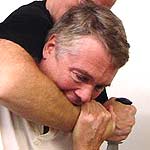
At this point it is usually quite easy to pivot to the left, inward under the opponent’s arm. But, if for some reason the pivot is blocked, or the attacker is just so strong compared to you that you can’t turn, bite down hard on the attacker’s wrist – doing your best “vicious dog” interpretation. This should loosen the attacker up.
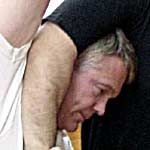
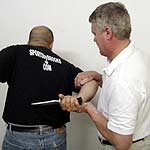
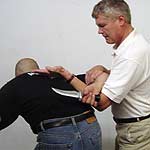
Continue your turn (an added possible distraction that is not shown in the illustration can be a sharp downward stomp of your heel against the attacker’s instep). As you continue to rotate you will find that your raised right arm will end up on top of the attacker’s shoulder or upper arm. As you complete the turn, pull your right hand down the arm across the bicep to the elbow – a continued pressure used to keep the elbow bent. Assisting in this “keeping the elbow bent” process is inward pressure on the attacker’s knife wrist by your left arm. If you step slightly behind the attacker, the elbow will continue to bend. Now let go of the attacker’s left wrist which you had grabbed with your left hand, and with the palm up, slide the arm up along the attacker’s back.
When practicing this move, at this point I often find myself also first striking to my opponents head with my right first (option not shown). Then I follow by putting my right palm on the opponent’s neck and executing a hard upward right knee kick (not shown)to the face (this helps drive the head upward so you can easily reach around with your arm).
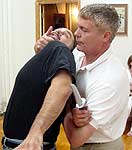
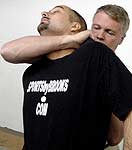
Now, reach around in front of the attacker’s head with your left arm. Here, there are a number of things you can do. You can pull the opponent’s face, turning it to the left, while you also pull his head back toward you (shown left photo). You can also reach around the attacker’s neck and back toward yourself to get a deep grip on the opponent’s shirt or jacket collar and then pull your arm tight across his neck for a choke (right photo) – which can cause unconsciousness.
Either position is quite painful, for the opponent’s arm bent like a “chicken wing” across his back, produces torque pressure in the shoulder – very painful and potentially. In any case you now have established control over your attacker. You can maneuver him if needed, use pain to force him to drop the knife, use pressure to tear shoulder muscles or dislocate the joint, or choke him out (if a choke hold was used).
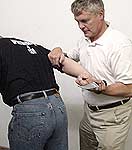
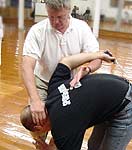
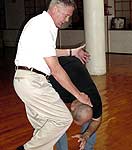
There are times, however, that even if you get control of the arm and rotate under it, the attacker is able to force his arm straight (first photo on left). If this happens don’t fight the straight arm. Go with the action by still slipping your left arm, palm up, under the straightened knife arm while stepping inward so the arm slips upward along the back. At the same time your right arm can press down on the opponent’s neck – a knee to the face can be added (middle photo). Since the knee to the head could not easily be seen in the third photo this sequence another photo was added (right photo) giving a side view of the knee to the head.
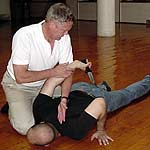 Use your left arm along the back to leverage up the attacker’s knife arm and press your right hand down on his neck (or upper arm) to take him to the ground, face down.(3) As you sink down your right knee can pin the attacker’s head (also painful) while your left arm pries the attacker’s left arm upward causing shoulder pain. In this position you can easily take away the knife while controlling the opponent.
Editor’s Note: This article in part relates to part 2 of my series, Fighting Back At 40,000 Feet, which discusses possible passenger strategies and techniques that could be used to resist and overcome terrorists trying to take control of an airplane. In part 2, the possibility of hostages held a knife point was discussed. This article addresses one knife scenario. See: Fighting Back At 40,000 Feet: Part 2 – Group Principles, Individual Strategies.
Footnotes:
(1) If you practice aikido or a number of other jujutsu systems your natural response in this situation might be to grab the opponents hand and wrist (in a different way than is illustrated above) so the palm of you hand lies on top of the attackers closed fist, thumb on top and fingers below.
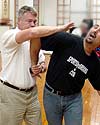
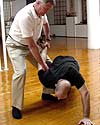
The disadvantage of this grip is that you only have thumb leverage in order to pull down and lock the opponent’s wrist to your chest. This is much weaker than using all of your fingers as in the illustration in the body of this article. At the same time, this position has an advantage. As you turn (keeping your left arm close to your chest) you can rotate the attacker’s wrist and lower arm to effect a nikyo (wrist) technique (photo at left) on the opponent, which torques his wrist and lower arm in such a way as to cause him pain while also keeping the arm bent usually this type technique is done with two hands). Here I prefer to continue the technique by bringing my right hand (already at the attacker’s shoulder area) down to the opponent’s upper arm (photo at right) to help leverage him to the ground, and/or hold him so he can be kicked in the head with my right foot and then taken down. At this point you can continue with a hold down technique as shown above.
(2) Interestingly this technique can be found in the karate kata, Pinan one. Part of the kata includes three steps forward, each step (into a front leaning stance) accompanied by upper blocks. Now visualize how an upper block is done. One arm is raised above the head (exactly the position of the right arm in the above self-defense technique) while the other, which had been held vertically in the center, is pulled down (some styles of karate do their upper blocks differently, in which case this example would not perfectly apply). This downward motion is the same as the grab and pull down on the knife hand used in the above situation. Both the kata and the self-defense technique also follow by a turn inward. In the kata this is seen a only a pivot, but in the self-defense technique it is a turn under the knife arm (the attack could also be a one arm, around the throat grab). Now in the kata the next move is a double are knife hand technique or block. In some styles a Shotokan karate this technique is sharper and more angled, while in other styles as Seido Karate and Kyokushin the block is more circular. In either case, however, the left forearm moves downward and the right forearm moves back toward the body. This is the same motion as when you have the opponent’s arm bent backward – you apply pressure out and downward with your forarm along his back. With the right arm you reach downward and around his head (pulling his head or in a choke) backwards toward your middle – just as the right hand in the kata.
(3) With the left arm across the opponent’s back, leveraging up the opponent’s arm, you can also just pivot your body to the left to move the attacker in circular takedown directed by you let hand (palm up).
About the Author Christopher Caile
Screenshot
Christopher Caile is the Founder and Editor-In-Chief of FightingArts.com. He has been a student of the martial arts for over 65 years.
He first started in judo while in college. Then he added karate as a student of Phil Koeppel in 1959 studying Kempo and Wado-Ryu karate. He later added Shotokan Karate where he was promoted to brown belt and taught beginner classes. In 1960 while living in Finland, Caile introduced karate to that country and placed fourth in that nation’s first national judo tournament.
Wanting to further his karate studies, Caile then hitch hiked from Finland to Japan traveling through Scandinavia, Europe, North Africa, the Middle East and South and Southeast Asia — living on 25 cents a day and often sleeping outside.
Arriving in Japan (1962), Caile was introduced to Mas Oyama and his fledgling full contact Kyokushinkai Karate by Donn Draeger, the famous martial artist and historian. Donn also housed him with several other senior international judo practitioners. Donn became Caile’s martial arts mentor, coaching him in judo and introducing him to Shinto Muso-ryu under Takaji Shimizu.
Caile studied at Oyama’s honbu dojo and also at Kenji Kurosaki’s second Tokyo Kyokushinkai dojo. In his first day in class Oyama asked Caile to teach English to his chief instructor, Tadashi Nakamura. They have been friends ever since. Caile also participated in Oyama’s masterwork book, “This Is Karate.”
Caile left Japan with his black belt and designation as Branch Chief, the first in the US to have had extensive training in Japan directly under Oyama Sensei. As such, Oyama Sensei asked him to be his representative on visits to his US dojos to report on their status.
A little over a year later, Nakamura, Kusosaki and Akio Fujihira won an epic David vs. Goliath challenge match against Thailand’s professional Muay Thai Boxers in Bangkok, Thailand, thrusting Kyolushinkai and Nakamura into national prominence.
Back in the US Caile taught Kyokushinkai karate in Peoria, Il while in college and later in Washington, DC. while in graduate school. Durimg this time Shihan Nakamura had moved to New York City to head Kyokushinkai’s North American Operation.
In 1976 when Kaicho Tadashi Nakamura formed the World Seido Karate organization, Caile followed. Living then in Buffalo, NY, Caile taught Seido karate and self-defense at the State University of New York at Buffalo (SUNY Buffalo) for over 15 years where he also frequently lectured on martial arts and Zen in courses on Japanese culture.
Caile moved to New York City in 1999 to marry Jackie Veit. He is now an 8th degree black belt, Hanshi, training in Seido Karate’s Westchester, NY Johshin Honzan (Spiritual Center) dojo. In Seido Caile is known for his teaching of and seminars on kata applications. He also produced a 14 segment video series on Pinan kata Bunkai currently available to Seido members.
Caile is also a long-time student and Shihan in Aikido. He studied in Buffalo, under Mike Hawley Shihan, and then under Wadokai Aikido’s founder, the late Roy Suenaka (uchi deshi under Morihei Ueshiba, founder of Aikido and was Shihan under Tohei Sensei). In karate, Suenaka (8thdan) was also an in-house student of the Okinawan karate master Hohan Soken.
Having moved to New York City, Caile in 2000 founded this martial arts educational website, FightingArts.com. Twenty-five years later, in 2025, it underwent a major update and revision.
For FightingArts.com and other publications Caile wrote hundreds of articles on karate, martial arts, Japanese art, Chinese Medicine and edited a book on Zen. He also developed relationships with a cross section of leading martial arts teachers. Over the last four decades he has conducted extensive private research into karate and martial arts including private translations of the once secret Okinawan hand copied and passed on Kung Fu book, the Bubishi, as well as an early karate book by the karate master Kenwa Mabuni. He periodically returns to Japan and Okinawa to continue his studies and participate Seido karate events. In Tokyo he practiced (with Roy Suenaka Sensei) in a variety of aikido organizations with their founders – including private interviews and practices at the Aiki-kai Aikido Honbu dojo with the son and grandson of aikido’s founder, Doshu (headmaster) Kisshomaru (an old uchi-deshi friend) and his son, Moriteru Ueshiba and in Iwama with Morihiro Saito. On Okinawa he studied Goju Ryu karate under Eiichi Miyazato, 10th dan founder of Naha’s Jundokan, and also with Yoshitaka Taira (who later formed his own organization, who specialized in kata Bunkai. While there Caile also trained with Hohan Soken’s senior student, Master Fusei Kise, 10 dan as well as with the grandson of the legendary karate master Anko Itosu.
Caile’s other martial arts experience includes: Diato-ryu Aikijujitsu and Kenjitsu, kobudo, boxing, Muay Thai, MMA, Kali (empty hand, knife and bolo), study of old Okinawan Shoran-ryu & Tomari body mechanics, study of old Okinawan kata under Richard Kim, study of close quarter defense and combat, including knife and gun defenses, Kyusho Jitsu and several Chinese fighting arts including 8 Star Praying Mantis, Pak Mei (White Eyebrow), and a private family system of Kung Fu.
Caile is also a student of Zen as well as a long-term student of one branch of Traditional Chinese Medicine, Chi Kung (Qigong). As one of two senior disciples of Chi Kung master Dr. Shen (M.D., Ph.D.) Caile was certified to teach and practice. This led to Caile’s founding of the The Chi Kung Healing Institute on Grand Island, NY. In Western NY, he also frequently held Chi Kung seminars, including at SUNY Buffalo and at the famous Chautauqua Institution in Chautauqua, NY. His articles on Chi Kung also appeared in the Holistic Health Journal and in several books on alternative medicine.
Caile holds a BA in International Studies from Bradley University and MA in International Relations with a specialty in South and Southeast Asia from American University in Washington, D.C. While in Buffalo, NY he also studied digital and analog electronics.
In his professional life Caile also worked in public relations and as a newspaper reporter and photographer. Earlier he worked in the field of telecommunications including Managing a Buffalo, NY sales and service branch for ITT. He then founded his own private telephone company. This was followed by creation of an electrical engineering company that designed and patented his concept for a new type of low-cost small business telephone system (which was eventually sold to Bell South). The company also did contract work for Kodak and the US space program. Simultaneously Caile designed and manufactured a unique break-apart portable pontoon boat.
Most recently Caile co-founded an internet software company. Its products include software suites with AI capability for control and management of streaming media, such as video and music, an all-in-one book publishing software product for hardcover, eBook and audio book creation and security software for buildings and government use.
For more details about Christopher Caile’s martial arts, work experience and life profile, see the About section in the footer of this site.
Search for more articles by this author: