

Advice On Surviving An Edged Weapon Attack
Reexamining Modern Knife Instruction for Civilians
By W.R. Mann
Editor’s Note: Defending against a knife is not a high percentage endeavor. Knife attacks are brutal, fast and often unpredictable. They can kill you. WR Mann’s approach is commendable. He avoids half-committed, non-realistic attacks and defenses. He has studied many systems of knife defense, distilled their lessons and developed realistic street-wise defenses that have been practiced and refined. In short, he knows what works and what doesn’t. If your knife defense training has been confined to the typical single thrust or slash attack, and ”I will hold it there until you do something” method, Mann’s training will be both eye opening and scary.
Many instructors who teach knife self-defenses to the general public don’t understand how knife attacks really occur.
A common mistake, for example, is to emphasize (or practice mostly) stick work, erroneously believing that developing stick skills will automatically transfer to unarmed defense against the knife.
The problem with this approach is that the vast majority of edged weapon attacks are sudden and without warning. In these situations victims have their hands so full just trying to avoid being stabbed, they have little time to pull out a weapon (even if they have one). In most cases the victim will be stabbed and perhaps not know it until afterwards. How is stick work relevant here?
There are some Filipino styles that do emphasize knife work, but mainly in an offensive capacity. They seem to delude themselves into believing that they will always be ready for any event. The reality is that bad things usually happen when you’re the least prepared for them. And for the most part, these styles don’t even teach any practical unarmed skills against a live blade.
That is not to say that I don’t practice knife-fighting (knife against knife). But I don’t do it to the exclusion of defensive knife work. I am also honest enough to realize that my chances are minimal when faced with an attacker armed with a knife. I also realize that I may not have a knife on me at all times, and even if I do have one, the chance that I can draw it in time against a determined attacker is not favorable.
So if the odds are stacked so heavily against you in the first place, why should you learn knife-defenses at all? For “knife awareness.” If you practice a program that includes a counter-knife component, you may be able to survive a knife attack, and that’s the point isn’t it? You probably won’t wipe the floor with your attacker, but it would be good to survive the assault.
Another mistaken strategy in my view is a tactic called “attack-the-attacker” – where you are told not to try to block a knife or pretend that the attacker doesn’t have one. This theory may work in certain situations, but it’s dangerous unless you’ve practiced it a great deal. Even if, as often suggested by those teaching this strategy, you succeed in jabbing your opponent’s eyes, the next step should either be to run away or to immobilize his arm. Blocking a knife-thrust with a limb and continuing on with an offensive technique is just ludicrous. If your instructor advocates this type of action, run away from him fast.
Two questions come to mind.
First, what types of attacks will the average citizen in a major urban environment be vulnerable to; and second, what do I have to look for, or even better, avoid, in terms of defensive-knife instruction?
In terms of types of attacks, I usually look at newspapers to see what’s happening in my area, but more importantly I ask law enforcement officers I know for their general take on the matter. The common consensus seems to be that edged-weapon assaults usually come via domestic disputes and/or street altercations. Many domestic disputes occur in the kitchen where knives and tools are readily available. In street disputes, individuals who are not at all reluctant to get into street fights are most often the type of individuals who will carry some sort of weapon. Bump into them on the wrong day and you could be in for it.
Other types of knife attacks are most commonly robberies and random assaults by deranged individuals. Victims of random assaults are always shocked by the event. They have a hard time believing they were targeted in the first place – it doesn’t make sense to them!
The Case for Proper Instruction
I used to be more critical of knife instructors in general; after all, poor instruction could potentially cost a student his or her life. But then I realized most knife-defense instructors didn’t know any better and no matter what I say, it wouldn’t change a thing. Nowadays I concentrate on providing useful and practical information to anyone, whether they practice kung-fu, kendo, combatives, Israeli styles or Filipino martial arts; anyone wishing to improve their odds of survival from a knife attack are welcome.
In general and especially with weapons, anything that can happen will happen, and anything can work. I never state that certain techniques cannot work in some situations, but I try to teach concepts that have more potential of success than others.
Defensive Strategies
No matter how strong or skilled you are, being close to a sharp piece of steel moving rapidly in your direction is not a good place to be. There is a good chance you will be cut and severely injured. The wisest course of action is immediately to turn and run away if the opportunity presents itself. Many martial artists claim that if you run, the attacker may chase you and still stab or cut you! But then again, most martial artists haven’t had any real fight experience. This philosophy comes from the martial arts mentality of “stay and fight” and has nothing to do with safety concerns.
So what if he chases you! Your attacker will not be able to inflict the same degree of damage on you if you are moving instead of just standing in front of him; with your throat, heart, stomach and liver within easy reach! If you run, you can always find objects to place between you and your attacker; you may even get the attention of police, or the attacker may think you’re not worth getting arrested for and leave. But your chances of surviving are far greater trying to escape.
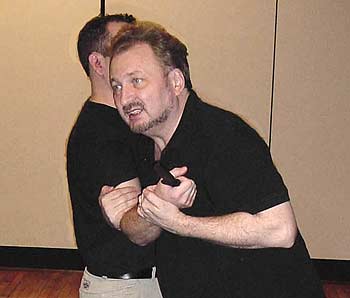
Demonstrating a defense against an attacker with a knife, WR Mann controls the attacker’s arm by gripping the upper arm and forearm. The key is to immobilize the arm and control the attacker with his own arm. Don’t loose control by trying to counter attack, such as blocking with one arm and attacking with the other. While doing so your attacker might just free his arm to launch a second or third attack.
If you can’t run, if you’re too close, or the attack is too sudden, what can you do? The best course of action in this case is to immobilize the attacking arm; instinctively and anyway you can. Not at the wrist or hand, but at the high bicep and junction of the elbow. You’re better able to control your attacker in this manner.
Attacks such as descending, ascending or straight thrusts or slashes are handled slightly differently, but the principle remains the same: immobilize the upper arm. At this point, if possible, bump or push the attacker, turn and run. If you feel this is not sufficient then you may have to bump/smash the attacker against a wall or trip him so he falls (all the while maintaining a firm grip on his arm). Note: after initially gripping the arm it’s important to bring his arm close to your body (either inside or outside). This will give you the power to neutralize his delivery system fully. It’s also vital to grab his shoulder and the area above his elbow for a stronger grip.
If you carry a large bag, case or any other object, and you’re too close to run away, use that bag or case as a shield between you and the attacker. Smash into him, push him off balance and run.
Don’t forget to yell or scream for help if you’re being attacked. In most large American cities, I’ve heard it is more beneficial to yell “Fire” than “Help.” It just gets more attention. Quite often people in large cities won’t help you because they’re scared, don’t want to get involved or think you are having a domestic dispute.
A Note On The Idea Of Running Away
There is something distressing about the way martial arts often train students not to run away. Even if they happen to successfully smash or push their opponents up against a wall or drop him to the floor, there is this silly ingrained habit of facing the opponent and getting into a rigid guard position. That may work in a tournament or the confines of a school, but don’t waste your precious time, or life. Ignore this misguided habit and get out of there as fast as you can. An average person with no training can run about 20 feet in a second, with some help from your adrenaline, you may cut that time down considerably.
All of these concepts mentioned above will give you a better chance of surviving an edged weapons attack. I personally know people who have used these methods and survived to talk about it. Unfortunately most knife instruction doesn’t include these concepts — that’s why I do.

W.R. Mann
W.R. Mann is an author, speaker and coach for a Reality-Based-Training (RBT) defensive survival program “DefenseScience.com”. He also headed Realfighting.com – He has written articles for Black Belt magazine, Budo magazine, FightingArts.com and USA dojo.com among others.
WR co-wrote an article about RBT in the “Martial Arts of the World, An Encyclopedia of History and Innovation.” He was also featured in a National Geographic special “The Use of the Bowie Knife in the Second Seminole War.” He has appeared in various martial related subjects on TV in Asia and North America.
WR’s background includes a lifelong study of traditional martial arts, close quarter combat and sports fighting since childhood including judo, traditional Japanese jujitsu, karate, boxing, wrestling, arnis, escrima and gun disarms.
WR was an early advocate of Reality-Based-Training and has taught Reality based Training defense seminars in 16 countries to law enforcement, military personnel, government agencies, martial artists civilians and young adults. Training focus includes the pre-physical conflict areas of awareness and avoidance in addition to physical defenses and technique (empty hand and weapon).
The Defense science program motto is: “We teach skills, that anyone can use to deal with a wide spectrum of situations from the smallest of daily intrusions right up to dealing with and winning a dangerous physical attack.
For more information contact:
Defensescience@gmail.com
Director@defensescience.com
Search for more articles by this author: