Fighting Zen
How Meditation Can Enhance Your Fighting Skills
By Christopher Caile

Editor’s Note: This is the third in a three article series on meditation (Zen) and the martial arts. This article discusses how Zen (meditation) skills are actually put to use in fighting and/or self-defense situations. Part one, “Holding Hands With Zen: The Martial Arts Connection – An Interview With Jeff Brooks,” discussed how Zen complements the martial arts by helping develop total concentration without thought, something that allows greater spontaneity of action. Part two, “Meditation – Just Do It!” by Jeff Brooks examined some of the techniques and methods of meditation itself.
Many martial arts students dismiss meditation as something that is not useful. It is perhaps interesting, they think, but has little to do with developing fighting ability. Are the two, in fact, related?
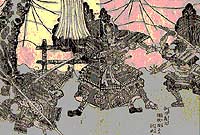 Historically we know that the Japanese samurai warrior often used meditation (Zen) as part of his training. And the samurai were noted for their total commitment to action – having an unsurpassed fearfulness and indomitable spirit – so much so that they are revered even to this day.
So what did they know that we don’t? How can something as peaceful, quiet and introspective as meditation be of any help to you in the midst of action and violence?
As an introduction to this subject I often ask my students, “How many of you have ever been in a car accident?” Always a few hands go up. I then ask what they remember and invariably a student will comment that everything seemed to go in slow motion as events unfolded – as if minutes replaced a fraction of a second.
So what did they know that we don’t? How can something as peaceful, quiet and introspective as meditation be of any help to you in the midst of action and violence?
As an introduction to this subject I often ask my students, “How many of you have ever been in a car accident?” Always a few hands go up. I then ask what they remember and invariably a student will comment that everything seemed to go in slow motion as events unfolded – as if minutes replaced a fraction of a second.
“This is a Zen moment in reverse,” I often tell them. You were so riveted by the intensity and danger of the moment that your mind was totally absorbed by it, something so emotionally powerful that events slowed. Unfortunately, too, the emotion is often so strong that people can’t react well and often freeze.
Meditation can work to achieve that same clarity, but it also helps in freeing you from the chains of emotion and thought that can slow your reactions. It can help you in any situation, especially when you are actually threatened.
A few years ago in Buffalo I saw an old friend on the street. We stopped to talk, and he had a huge shiner (black and blue eye). “What happened?” I asked (I really wondered, since he was a well known teacher of a Chinese martial art). He seemed embarrassed, to say the least. Finally with a little prodding he explained that he had been attacked by two young men outside a bar. One pulled a knife while the other had sent him reeling by a haymaker. “I don’t know how it happened,” he said. “I guess I just freaked. I didn’t see the punch coming. All I could see was the knife.”
That type of reaction, just like in a car accident, is not uncommon. And most people, even martial artists, aren’t prepared.
Police reports often tell of policemen faced with a high stress, threatening situation, who react like the driver in a car accident. They report that things slowed down, but often too the correct actions were not forthcoming. Here training helps.
The samurai warrior (at least in the times of civil warfare) used a lot of tools to prepare themselves – strict discipline, hard, relentless training, meditation (Zen), and often self-hypnosis (Esoteric Buddhist practices) wrapped in a culture and tradition of absolute commitment and service. The mind and spirit were developed as readily as physical and technical skills.
One of the primary differences between the classical martial arts and sports as we know them in the west is this mental conditioning and training. This conditioning has in some part been carried over to modern martial arts, such as judo, karate-do, kendo and aikido. The goal of the “do” (the way) arts has been to preserve and foster the same spirit, commitment to purpose and mental development that once characterized the samurai.
In the west, even the most basic concepts of what we know as sports psychology didn’t develop until the 1970s. People were often excellent athletes, but mentally they had little preparation. In contrast, the emphasis on mental conditioning as seen in classical martial arts (and in some do arts) can actually work to initially slow physical skill development. Thus, the western athlete often develops faster. But, at the highest level of performance enhanced mental skills provide an edge. They can free the body to achieve a higher level of physical performance. Matched against each other, and with equal skills the athlete or martial artist with the superior mind set will have advantage.
Thus, in hand to hand warfare or combat, the mind often provides the edge. Mediation is one of the tools to prepare the mind for high stress combat situations. The idea was to prepare the mind so it will not be inhibited by thoughts, intense emotions, fear, and automatic body reactions.
There are many legends about the superior fighting abilities of Zen monks based on their mindset. In the 17th century, there was a famous Zen master Shoju Rojin, a bastard son of a Samurai family who suffered a near death experience and went on to study Zen. He lived as a hermit. One day a group of swordsmen began practicing nearby, and during a pause one came up to him. The Samurai boasted that while the monk’s concentration was superior to theirs, theirs was superior in terms of practicality. Taking an opportunity to demonstrate their error, the monk suggested that the warrior try to cut him with his sword. He said that he would only use his fan (which had a metal backing that allowed it to be used as a defensive instrument). The swordsman attacked from every angle, but each blow was deftly parried. Finally exhausted the warrior was forced to concede that the monk’s abstract concentration was capable of concrete use.
When the warrior asked how the monk was able to do this, he replied, ”It’s simple. When your objective perception is clear, you don’t miss one of ten thousand things.”
|
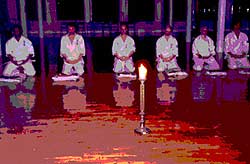
To understand this concept, let’s examine meditation. When you sit, you relax in a comfortable position, withdraw your attention while remaining alert, and clear the mind of thoughts, emotions and feelings. Often students are told to concentrate on their breath and count to ten, but to start again if a thought, image or feeling jumps in.). Sitting like this you often feel drowsy and the mind can wonder. Don’t let it. All kinds of images and thoughts flash into the mind. You also feel twitches, and itches, and your legs often feel uncomfortable as your mind starts its own little rebellion. But the idea is not to move or scratch, but just to sit, awake with as clear a mind as possible. After a while practicing old emotions or memories also bubble up. You just sit. It can be the most difficult thing you ever have done – nothing. And it takes a lot of time, years to develop.
Over time just sitting can produce internal changes that transform normal perceptions and awareness and develop them beyond the norm. You concentration evolves – toward state of total focused awareness that allows the slightest nuance of perception or intuition to be acknowledged and not be clouded by prior experience, or filtered out by distraction or inattentiveness, or colored by emotion. At its highest distinctions between the viewer and others or objects are reduced or even eliminated – a physiological state which allows the unconscious mind and body act freely to use the training programmed into the muscles and auto responses of the body.
Many people think of Zen as a religion, Buddhism. Yes, it is this, but it can also be practiced as a mental practice devoid of religion. This is the meditation I am discussing here. I used to attend a Zen monastery just north of New York City in the Catskills and was often surprised to find people of all religions. There was even a priests that often attended.
In Japan too, it was not just the samurai who used Zen’s meditative mind set. A friend of mine who lives in Japan took a class in flower arranging. She noted that the biggest difference between western florists and those she studied with was the ability to work without thought. “In the US,” she said, “I thought a lot about how things were arranged, while in Japan I was encouraged not to.” This same mindset is also found in those who perform the Japanese tea ceremony (Chado).
But in fighting the challenge of clear mind, clear perception, is greater because the mind has greater assaults. A samurai going into battle knew that he would often fight another, face to face, and that one or both of them would die. But even in hard competitive sports the mental barriers can be challenging. Again it depends on the level of physical combat and danger.
In point or light contact practice fighting you can develop your movement and reflexes, but your mind isn’t really threatened. You might lose a point or be made to look bad, but that’s a loss of ego. Even if you practice heavier contact, rules and safety equipment usually protect you. You may fear getting an injury, but this is a far cry from the fear of possibly getting really hurt, or even worse – killed. A real confrontation or attack creates a cascade of emotion and fear not experienced in tame dojo exercises.
Anger can be just as bad. It can build up, flair the nostrils and make you want to strike out or kill – something that can also make you forget everything you have learned – your training, common sense, and even your own safety.
|
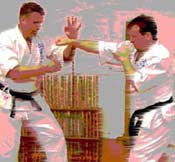
I learned quite a bit about the mental side of martial arts early on. It was 1961 in Japan. I was 18, a new student of Mas Oyama’s Kyokushinkai karate. And kumite (practice fighting) was violent. I was often frozen. Day after day in class I knew I was going to get hurt again. And there in front of me would be my opponent, arms out in front of him and often with a slight smile. Day after day I would be knocked to the ground, struggle up to be knocked down again. Over the first few months my toes got so red and swollen they could hardly bend. My shins became black and blue and swollen. I had broken knuckles and cracked ribs. I suffered a cracked jaw, and teeth had been kicked out, wired in only to be kicked out again. And each day I would be there again fighting. I remember how I would set my defense and wait. I would try to think of how to avoid the attack, of the techniques the my opponent had used before, of what I should do. It didn’t help. And I had hitch hiked half way around the world and signed up for this.
Late one night I talked the situation over with Donn Drager with whom I was living in Tokyo. Donn talked about fear and how it could overwhelm. “If you are afraid of the sword, you will die by it,” he said. He knew I mediated and advised me to use what I had learned. “Stop thinking,” he said “and just accept the pain, almost welcome it.” He pointed to his head and said “it’s this that is getting you hurt. Tomorrow just relax and try to see your opponent as clearly as yourself, with the same clarity of mind as when you meditate.” Wise words. That night I meditated again. I also pictured kumite (practice fighting) and how I would clear my mind and not think of how to fight. I did this for hours. And the next day was the first day I wasn’t hurt in practice fighting. Donn’s advice provided a turning point for me, Zen advice for my sorely aching body. I must have evolved to a point where just a little push moved me over the mental edge to another state of consciousness.
I had been introduced to meditation while making my way to Japan. I had been hitchhiking up through the jungles in the panhandle of Thailand from Malaysia. Along the way I slept outside in a small village. A Buddhist monk somehow heard there was a stranger visiting in the area who spoke English, and he sought me out. He invited me to visit his Buddhist monastery with the idea that he could practice his English. It was there that I learned about meditation. For about there weeks I sat daily with a group of 100 monks dressed in bright orange robes. I found solace in the mediation and thereafter started practicing regularly.
Donn’s advice was reflected years later when I read what was to become one of my favorite books, ”The Unfettered Mind.” The book features the writings of the famous Zen Monk Takuan Soho (translated by William Scott Wilson) (1) that were addressed to a master of the sword. Soho talks of “stopping the mind,” of how judgments or thoughts of the attack, the other’s intention, or your own defense, even fear, can undermine you by detaining the mind.
|

In the story about the Chinese teacher of martial arts noted above, his mind was actually frozen by fear, which stopped his body from reacting. Years of training meant nothing. “If your mind is diverted in any way, you will falter,” consoled Takuan Soho. “The mind must be immovable – that is, not distracted, detained or occupied by any thought, judgment or emotion – not congealed in one place but instead stretched through the entire body and self. It must have a total awareness and sensitivity without focus, and thus will be able to flow with events without getting attached to them (No-Mind, No-Thought).”
If one empties the mind, the function of the intellect disappears –“arms, legs and body remember what to do, but the mind does not enter into this at all,” said Takuan Soho.
All this adds up to one point: meditation helps you get your mind out of your fight. Just as in meditation, in fighting you try to maintain clarity of conscious. Don’t think what you should do, don’t try of guess what the opponent’s technique or techniques will be, don’t let fear strangle your reactions or hold you back. Let your consciousness become one with your opponent so that you almost feel a part of him or her, so much so you can sense an offensive technique even before it appears. And when a technique is thrown, don’t focus on it. Block, avoid or absorb the technique, but always look, feel and let your mind use its intuition to sense the next action, the following technique or movement.
This mental state will let you react faster, move more spontaneously, see things as they happen or intuitively sense things as they are about to happen. For some, action will actually seem to slow down. This slowing down of action is not exclusive to the martial arts. Other athletes sometimes call it the “Getting in the Zone.” Baseball player Ted Williams is often quoted as saying that when he was at bat, he could actually see the stitches on the baseball turn over as the ball came toward him. Hockey goalie Dominick Hasek likewise commented in a post-game interview in 1997, when he was asked about his phenomenal goal blocking ability, that for him the puck seemed to slow down so it was easy to see and block.
Footnote:
(1) Takuan Soho(1573-1600) was a famed Zen monk, noted calligrapher and painter, poet and tea master. He was very prodigious in his writings. He was advisor and teacher to the Japanese emperor and Shogun and is even credited with inspiring the famous Japanese swordman Miyamato Musahi.

About the Author Christopher Caile
Screenshot
Christopher Caile is the Founder and Editor-In-Chief of FightingArts.com. He has been a student of the martial arts for over 65 years.
He first started in judo while in college. Then he added karate as a student of Phil Koeppel in 1959 studying Kempo and Wado-Ryu karate. He later added Shotokan Karate where he was promoted to brown belt and taught beginner classes. In 1960 while living in Finland, Caile introduced karate to that country and placed fourth in that nation’s first national judo tournament.
Wanting to further his karate studies, Caile then hitch hiked from Finland to Japan traveling through Scandinavia, Europe, North Africa, the Middle East and South and Southeast Asia — living on 25 cents a day and often sleeping outside.
Arriving in Japan (1962), Caile was introduced to Mas Oyama and his fledgling full contact Kyokushinkai Karate by Donn Draeger, the famous martial artist and historian. Donn also housed him with several other senior international judo practitioners. Donn became Caile’s martial arts mentor, coaching him in judo and introducing him to Shinto Muso-ryu under Takaji Shimizu.
Caile studied at Oyama’s honbu dojo and also at Kenji Kurosaki’s second Tokyo Kyokushinkai dojo. In his first day in class Oyama asked Caile to teach English to his chief instructor, Tadashi Nakamura. They have been friends ever since. Caile also participated in Oyama’s masterwork book, “This Is Karate.”
Caile left Japan with his black belt and designation as Branch Chief, the first in the US to have had extensive training in Japan directly under Oyama Sensei. As such, Oyama Sensei asked him to be his representative on visits to his US dojos to report on their status.
A little over a year later, Nakamura, Kusosaki and Akio Fujihira won an epic David vs. Goliath challenge match against Thailand’s professional Muay Thai Boxers in Bangkok, Thailand, thrusting Kyolushinkai and Nakamura into national prominence.
Back in the US Caile taught Kyokushinkai karate in Peoria, Il while in college and later in Washington, DC. while in graduate school. Durimg this time Shihan Nakamura had moved to New York City to head Kyokushinkai’s North American Operation.
In 1976 when Kaicho Tadashi Nakamura formed the World Seido Karate organization, Caile followed. Living then in Buffalo, NY, Caile taught Seido karate and self-defense at the State University of New York at Buffalo (SUNY Buffalo) for over 15 years where he also frequently lectured on martial arts and Zen in courses on Japanese culture.
Caile moved to New York City in 1999 to marry Jackie Veit. He is now an 8th degree black belt, Hanshi, training in Seido Karate’s Westchester, NY Johshin Honzan (Spiritual Center) dojo. In Seido Caile is known for his teaching of and seminars on kata applications. He also produced a 14 segment video series on Pinan kata Bunkai currently available to Seido members.
Caile is also a long-time student and Shihan in Aikido. He studied in Buffalo, under Mike Hawley Shihan, and then under Wadokai Aikido’s founder, the late Roy Suenaka (uchi deshi under Morihei Ueshiba, founder of Aikido and was Shihan under Tohei Sensei). In karate, Suenaka (8thdan) was also an in-house student of the Okinawan karate master Hohan Soken.
Having moved to New York City, Caile in 2000 founded this martial arts educational website, FightingArts.com. Twenty-five years later, in 2025, it underwent a major update and revision.
For FightingArts.com and other publications Caile wrote hundreds of articles on karate, martial arts, Japanese art, Chinese Medicine and edited a book on Zen. He also developed relationships with a cross section of leading martial arts teachers. Over the last four decades he has conducted extensive private research into karate and martial arts including private translations of the once secret Okinawan hand copied and passed on Kung Fu book, the Bubishi, as well as an early karate book by the karate master Kenwa Mabuni. He periodically returns to Japan and Okinawa to continue his studies and participate Seido karate events. In Tokyo he practiced (with Roy Suenaka Sensei) in a variety of aikido organizations with their founders – including private interviews and practices at the Aiki-kai Aikido Honbu dojo with the son and grandson of aikido’s founder, Doshu (headmaster) Kisshomaru (an old uchi-deshi friend) and his son, Moriteru Ueshiba and in Iwama with Morihiro Saito. On Okinawa he studied Goju Ryu karate under Eiichi Miyazato, 10th dan founder of Naha’s Jundokan, and also with Yoshitaka Taira (who later formed his own organization, who specialized in kata Bunkai. While there Caile also trained with Hohan Soken’s senior student, Master Fusei Kise, 10 dan as well as with the grandson of the legendary karate master Anko Itosu.
Caile’s other martial arts experience includes: Diato-ryu Aikijujitsu and Kenjitsu, kobudo, boxing, Muay Thai, MMA, Kali (empty hand, knife and bolo), study of old Okinawan Shoran-ryu & Tomari body mechanics, study of old Okinawan kata under Richard Kim, study of close quarter defense and combat, including knife and gun defenses, Kyusho Jitsu and several Chinese fighting arts including 8 Star Praying Mantis, Pak Mei (White Eyebrow), and a private family system of Kung Fu.
Caile is also a student of Zen as well as a long-term student of one branch of Traditional Chinese Medicine, Chi Kung (Qigong). As one of two senior disciples of Chi Kung master Dr. Shen (M.D., Ph.D.) Caile was certified to teach and practice. This led to Caile’s founding of the The Chi Kung Healing Institute on Grand Island, NY. In Western NY, he also frequently held Chi Kung seminars, including at SUNY Buffalo and at the famous Chautauqua Institution in Chautauqua, NY. His articles on Chi Kung also appeared in the Holistic Health Journal and in several books on alternative medicine.
Caile holds a BA in International Studies from Bradley University and MA in International Relations with a specialty in South and Southeast Asia from American University in Washington, D.C. While in Buffalo, NY he also studied digital and analog electronics.
In his professional life Caile also worked in public relations and as a newspaper reporter and photographer. Earlier he worked in the field of telecommunications including Managing a Buffalo, NY sales and service branch for ITT. He then founded his own private telephone company. This was followed by creation of an electrical engineering company that designed and patented his concept for a new type of low-cost small business telephone system (which was eventually sold to Bell South). The company also did contract work for Kodak and the US space program. Simultaneously Caile designed and manufactured a unique break-apart portable pontoon boat.
Most recently Caile co-founded an internet software company. Its products include software suites with AI capability for control and management of streaming media, such as video and music, an all-in-one book publishing software product for hardcover, eBook and audio book creation and security software for buildings and government use.
For more details about Christopher Caile’s martial arts, work experience and life profile, see the About section in the footer of this site.
Search for more articles by this author: