
For The Sake Of Safety: Hand Sparring Gear And The Loss Of Hand Techniques
By Christopher Caile
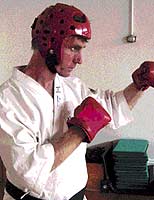
Protective equipment on the hands and feet during sparring in karate, taekwondo and in many kung fu styles has it increased safety, but have they also created a new set of problems?
|
 With safety equipment grabbing, pulling in, catching an arm and some blocks, such as a wrist blocks have all been eliminated. With thick glove padding hand techniques are now only blunt instrument hits that emphasis power.
Using safety equipment during sparring has affected a lot of technique – especially those of the hand. The palm strike and bent wrist block have all but disappeared, and grabbing has been virtually eliminated too. Furthermore the knuckles have become so padded in foam or other material that they have become solely instruments of blunt power attacks. In short, is safety equipment turning karate into a power punch and kick art?
Of course sparring was always regulated in the name of safety. Targets were limited and certain techniques were not allowed such as elbow and knee strikes, attacks to the neck, spine or eyes, etc. In many styles the legs were off bounds too. But still, participants had some freedom to utilize many of the grabbing, trapping, sweeping and other techniques – those same techniques found in kata, and which help define the art form.
Before safety equipment was adopted sparring often involved grabbing another at the chest or shoulder and pulling in, pushing, or grabbing an arm to control it or effect a sweep. The variety of techniques was much greater than found today. Since in many karate, taekwondo and kung fu schools sparring is virtually the only person on person fighting practice people get, this reduction in technique can prove to be a limitation.
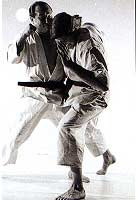
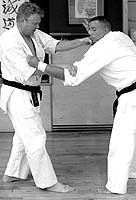
Without safety equipment sparring used to be much more rough and tumble with fighters exercising many grabbing and catching techniques. At left Mas Oyama is seen catching this author’s neck to pull in for a punch during sparring during a photo session for his book, “This Is Karate” (1961 in Tokyo). This type of technique directly translates into self-defense. At right this author demonstrates a self-defense technique against a grab and punch attack (Seido Karate Honbu Seminar 1992).
So, what happens on the street, if and when the martial artist comes face to face with a real threat? Well, the many knife/spear hand attacks, grabs, off-balances, elbows, knees, head butts, groin and kidney strikes and pressure point techniques found in kata, just aren’t practiced. Without practice they become irrelevant, something the mind might be aware of, but not trained into the instinctive and reactive muscle memory of the body. And what has been trained within sparring is further reduced by the limitations imposed by protective equipment.
Remember the original purpose of karate and kung fu was self-defense. This is not to say that sparring should not be safe, or that safety equipment should not be used. But, it does suggest that students should also practice real street self-defense and that effective techniques should not be eliminated just because they don’t belong in sparring.
How many advanced, highly ranked martial artists do you know who would have no idea how to react if someone grabbed their hair and pulled them (hard) forward and down? I can tell you that in self-defense seminar after seminar, those I have tested have been totally befuddled by this and a variety of other street type attacks.
This is not to say that sparring and competition can be very important. They provide valuable experience in one-on-one simulated combat, build confidence and develop coordination, skill and a sense of timing. Safety equipment can also help avoid injury and this is a plus.
But sparring and safety in sparring (use of protective equipment) should not be over emphasized at the expense of kata (with applications) and realistic self-defense training. To be prepared for the street, the martial artist should be trained in defensive and counter techniques and tactics, done without protective equipment, and under supervision.
The more realistic the attack and defense, the more the participants will actually be prepared of a real life assault. This will produce more well rounded karate, taekwondo or kung fu practitioner, one who just might thank his teacher if he is ever actually attacked on the street.

About the Author Christopher Caile
Screenshot
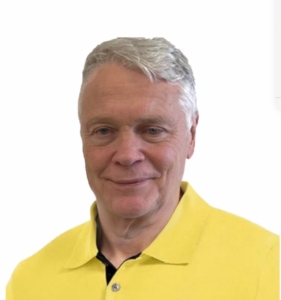
Christopher Caile is the Founder and Editor-In-Chief of FightingArts.com. He has been a student of the martial arts for over 65 years.
He first started in judo while in college. Then he added karate as a student of Phil Koeppel in 1959 studying Kempo and Wado-Ryu karate. He later added Shotokan Karate where he was promoted to brown belt and taught beginner classes. In 1960 while living in Finland, Caile introduced karate to that country and placed fourth in that nation’s first national judo tournament.
Wanting to further his karate studies, Caile then hitch hiked from Finland to Japan traveling through Scandinavia, Europe, North Africa, the Middle East and South and Southeast Asia — living on 25 cents a day and often sleeping outside.
Arriving in Japan (1962), Caile was introduced to Mas Oyama and his fledgling full contact Kyokushinkai Karate by Donn Draeger, the famous martial artist and historian. Donn also housed him with several other senior international judo practitioners. Donn became Caile’s martial arts mentor, coaching him in judo and introducing him to Shinto Muso-ryu under Takaji Shimizu.
Caile studied at Oyama’s honbu dojo and also at Kenji Kurosaki’s second Tokyo Kyokushinkai dojo. In his first day in class Oyama asked Caile to teach English to his chief instructor, Tadashi Nakamura. They have been friends ever since. Caile also participated in Oyama’s masterwork book, “This Is Karate.”
Caile left Japan with his black belt and designation as Branch Chief, the first in the US to have had extensive training in Japan directly under Oyama Sensei. As such, Oyama Sensei asked him to be his representative on visits to his US dojos to report on their status.
A little over a year later, Nakamura, Kusosaki and Akio Fujihira won an epic David vs. Goliath challenge match against Thailand’s professional Muay Thai Boxers in Bangkok, Thailand, thrusting Kyolushinkai and Nakamura into national prominence.
Back in the US Caile taught Kyokushinkai karate in Peoria, Il while in college and later in Washington, DC. while in graduate school. Durimg this time Shihan Nakamura had moved to New York City to head Kyokushinkai’s North American Operation.
In 1976 when Kaicho Tadashi Nakamura formed the World Seido Karate organization, Caile followed. Living then in Buffalo, NY, Caile taught Seido karate and self-defense at the State University of New York at Buffalo (SUNY Buffalo) for over 15 years where he also frequently lectured on martial arts and Zen in courses on Japanese culture.
Caile moved to New York City in 1999 to marry Jackie Veit. He is now an 8th degree black belt, Hanshi, training in Seido Karate’s Westchester, NY Johshin Honzan (Spiritual Center) dojo. In Seido Caile is known for his teaching of and seminars on kata applications. He also produced a 14 segment video series on Pinan kata Bunkai currently available to Seido members.
Caile is also a long-time student and Shihan in Aikido. He studied in Buffalo, under Mike Hawley Shihan, and then under Wadokai Aikido’s founder, the late Roy Suenaka (uchi deshi under Morihei Ueshiba, founder of Aikido and was Shihan under Tohei Sensei). In karate, Suenaka (8thdan) was also an in-house student of the Okinawan karate master Hohan Soken.
Having moved to New York City, Caile in 2000 founded this martial arts educational website, FightingArts.com. Twenty-five years later, in 2025, it underwent a major update and revision.
For FightingArts.com and other publications Caile wrote hundreds of articles on karate, martial arts, Japanese art, Chinese Medicine and edited a book on Zen. He also developed relationships with a cross section of leading martial arts teachers. Over the last four decades he has conducted extensive private research into karate and martial arts including private translations of the once secret Okinawan hand copied and passed on Kung Fu book, the Bubishi, as well as an early karate book by the karate master Kenwa Mabuni. He periodically returns to Japan and Okinawa to continue his studies and participate Seido karate events. In Tokyo he practiced (with Roy Suenaka Sensei) in a variety of aikido organizations with their founders – including private interviews and practices at the Aiki-kai Aikido Honbu dojo with the son and grandson of aikido’s founder, Doshu (headmaster) Kisshomaru (an old uchi-deshi friend) and his son, Moriteru Ueshiba and in Iwama with Morihiro Saito. On Okinawa he studied Goju Ryu karate under Eiichi Miyazato, 10th dan founder of Naha’s Jundokan, and also with Yoshitaka Taira (who later formed his own organization, who specialized in kata Bunkai. While there Caile also trained with Hohan Soken’s senior student, Master Fusei Kise, 10 dan as well as with the grandson of the legendary karate master Anko Itosu.
Caile’s other martial arts experience includes: Diato-ryu Aikijujitsu and Kenjitsu, kobudo, boxing, Muay Thai, MMA, Kali (empty hand, knife and bolo), study of old Okinawan Shoran-ryu & Tomari body mechanics, study of old Okinawan kata under Richard Kim, study of close quarter defense and combat, including knife and gun defenses, Kyusho Jitsu and several Chinese fighting arts including 8 Star Praying Mantis, Pak Mei (White Eyebrow), and a private family system of Kung Fu.
Caile is also a student of Zen as well as a long-term student of one branch of Traditional Chinese Medicine, Chi Kung (Qigong). As one of two senior disciples of Chi Kung master Dr. Shen (M.D., Ph.D.) Caile was certified to teach and practice. This led to Caile’s founding of the The Chi Kung Healing Institute on Grand Island, NY. In Western NY, he also frequently held Chi Kung seminars, including at SUNY Buffalo and at the famous Chautauqua Institution in Chautauqua, NY. His articles on Chi Kung also appeared in the Holistic Health Journal and in several books on alternative medicine.
Caile holds a BA in International Studies from Bradley University and MA in International Relations with a specialty in South and Southeast Asia from American University in Washington, D.C. While in Buffalo, NY he also studied digital and analog electronics.
In his professional life Caile also worked in public relations and as a newspaper reporter and photographer. Earlier he worked in the field of telecommunications including Managing a Buffalo, NY sales and service branch for ITT. He then founded his own private telephone company. This was followed by creation of an electrical engineering company that designed and patented his concept for a new type of low-cost small business telephone system (which was eventually sold to Bell South). The company also did contract work for Kodak and the US space program. Simultaneously Caile designed and manufactured a unique break-apart portable pontoon boat.
Most recently Caile co-founded an internet software company. Its products include software suites with AI capability for control and management of streaming media, such as video and music, an all-in-one book publishing software product for hardcover, eBook and audio book creation and security software for buildings and government use.
For more details about Christopher Caile’s martial arts, work experience and life profile, see the About section in the footer of this site.
Search for more articles by this author: