
Martial Mania
Acquired Stupidity Syndrome
By George Donahue
In the Japanese-English martial arts dictionary that Sara Aoyama and I are slowly compiling, there is a condition we couldn’t translate directly into English. So, when we were working through that section of the dictionary about a half dozen years ago, I coined a new term: Acquired Stupidity Syndrome. For short, I call this condition by its acronym, “ASS,” and I sometimes uncharitably call its victims “asses.” I shouldn’t do that, and I usually catch myself in time. That’s good for me, because I don’t wish to be uncharitable toward the afflicted and also because some of those afflicted are “hard asses” who might make my existence a little less pleasant.
Acquired Stupidity Syndrome is a condition you often see in kids, especially two-year-olds and teenagers, but it’s just a passing phase for the former and the latter usually outgrow it after several miserable (for all concerned) years, unless they’re ambitious for careers as bureaucrats or politicians.
ASS is different from just plain stupidity, which can’t be helped. With ASS, the sufferer must, in one way or another “volunteer” to be afflicted. There are many preconditions for volunteering, chief among them greed, anger/fear, emotional insecurity, and, for teens, hormonal surges. There is also a paradox that comes with ASS — the deeper the affliction, the stronger the afflicted person’s denial that he or she is afflicted. The norm is that the deeper the affliction, the more the afflicted person believes himself or herself to be unusually intelligent, wise, and in all ways superior. In my work as an editor, I’ve found this to be true with many authors, even with fiction writers. (Some, of course, have accused me of being an ass, too.)
You also see ASS too often in martial arts. From an outsider’s perspective, it seems as though whole martial systems or organizations are mired in ASS. In general, however, it’s not the system itself that is afflicted but its adherents, who somehow have managed to embed themselves into its fabric and thus retard its expression and development. Unfortunately, not many afflicted martial artists outgrow ASS. For them, it’s terminal — they practice their martial arts in willful stupidity and they die, at best, in ignorant bliss.
Why does it matter?
It matters because many of these asses are martial arts instructors, and they, often with the best of myopic intentions, do their best to pass along their asinine ignorance. There is an unfortunate preponderance of asses in the higher ranks of martial arts organizations, too. On an immediate, personal level, it also matters because sometimes the afflicted find themselves in danger, and they are not prepared. In fact, ASS often leads the afflicted into unnecessary, easily avoidable danger. It’s a sad reality that ASS even renders afflicted students into easily exploited, manipulated, and abused victims of unscrupulous instructors (who are a different sort of ass).
So how do you, as a sincere student of your particular martial art who wishes to make real progress toward really mastering it, determine whether your teacher is an ass or you yourself are an ass? Or, for that matter, whether the martial way you follow is not itself thoroughly larded with ASS? Unfortunately, it would take hours to list all the signs of the syndrome, so making a checklist is impracticable. However, to get started, here are some things to think about in determining whether you, your teachers, or your system are afflicted by Acquired Stupidity Syndrome:
Does every exercise, drill, or technique your style or organization requires come with a solid explanation of what purpose it serves, and is it rooted in sound physiological, psychological, and legal ground?
Do questions remain unanswered or ignored, or worse, are they answered perfunctorily and without the strength of reason? Or ridiculed?
Are style historical/authenticity claims mysteriously undocumented?
Are the social norms and expected behavior reasonable and productive, or do you get the feeling that they derive from a third-rate anime movie?
Are training doctrines and techniques ever really put to a test?
Are you required to exhibit militaristic subservience or automatic, reflexive denigration of outsiders (other styles, teachers, students)?
Are you required to buy into any cultish behavior in order to remain in good standing?
Is fear of any sort used to keep adherents in line?
Does your wallet begin to seem like a cash machine for everyone but you?
We could go on, but that would be too depressing and I think you’ve got enough to work with now.
Copyright © 2008 George Donahue & FightingArts.com. All rights reserved.
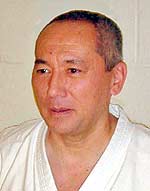
George Donahue
George has been on the board of FightingArts.com since its inception and is also a Contributing Editor.
George is a retired book editor, with a career spanning four decades, among his positions have been editorial stints at Random House; Tuttle Publishing, where he was the executive editor, martial arts editor, and Asian culture editor; and Lyons Press, where he was the senior acquisitions editor and where he established a martial arts publishing program. At Tuttle, he was the in-house editor for the Bruce Lee Library. Throughout his career he also edited, acquired, or reissued a wide array of military history, martial arts, and Asia-centric titles.
He was born in Japan in 1951 and originally named Fujita Tojo, with the Buddhist name KanZan. He was renamed George Donahue when he was several months old. After living part of his early childhood in the U.S. and France, he returned to Japan when he was seven years old and immediately was put (involuntarily) into intense training in traditional Japanese martial arts. His childhood training in Japan was focused on judo and jujutsu, primarily with Ando Shunnosuke, who blended keisatsujutsu (often referred to as police judo) and Olympic style judo in his teaching. He also studied kyujutsu (archery), sojutsu (spear), and kenjutsu (swordsmanship), with several teachers under the direction of his uncle, Tomita Yutaka. Following his return to the U.S. when he was twelve years old, he continued to practice judo and jujutsu, as well as marksmanship with Western style compound bow and firearms, and began the study of Matsubayashi Ryu karate in his late teens. Subsequently, he has studied aikido and cross trained in Ying Jow Pai kung fu. He began studying tai chi chuan in 1973 and now teaches qi gong and tai chi for health and fitness, as well as Okinawa Taijiken, which blends the principals of Okinawan karate with tai chi.
After studying Okinawa Karatedo Matsubayashi Ryu for ten years, he changed his focus to the teaching of Kishaba Chokei. He has been a student of Shinzato Katsuhiko, the director of Okinawa Karatedo Shorin Ryu Kishaba Juku, which comprises karate and kobujutsu (including Yamane Ryu Bojutsu) since 1983. He was also a student of Nagamine Shoshin, Nagamine Takayoshi, Kishaba Chokei, and Nakamura Seigi until their deaths. A key teacher in the U.S. was Arthur Ng, with whom he trained and taught for several years in New York City. He currently teaches Kishaba Juku privately, along with special training in karate, weapons, and self-defense. He has taught seminars throughout the U.S. and in Israel.
He has been teaching martial arts almost continually for sixty years. His first class, at twelve years old, was in judo for a group of military dependents and airmen at Sioux City Air Base, Iowa, at a time when the Air Force Strategic Air Command was beginning to stress training in martial arts, particularly jujutsu.
He was introduced to Kundalini Yoga practice in Japan but didn’t begin serious practice of Kundalini and Hatha Yoga until he was in college. He practices yoga at least an hour a day and now teaches various approaches to yoga. He is also a cancer exercise specialist and a Livestrong at the YMCA instructor, helping cancer survivors regain and maintain their vitality.
Search for more articles by this author: