
Martial Mania
Nippon Hamu
By George Donahue
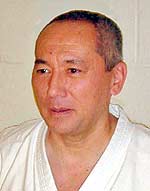
Many Western actors who would never think of sullying themselves by doing commercial endorsements in their home countries are more than happy to shill for products in Japan and the rest of Asia. One who comes immediately to mind is an American famous for his macho action roles, in which he says very little and hardly ever cracks a smile. He’s done nothing in the US, ever, to weaken his stone-face auteur image. He’s a “serious” actor and director. In Japan, however, for several years, he was, probably inadvertently, the jovial spokesman for Nippon Hamu (pushing hamu and beikon) and is probably better loved there for his commercials (in which he speaks a little heavily coached Japanese) than for his tedious, predictable movies. Nippon Hamu is — after SPAM, of course — the premier producer and marketer of processed pork products in Asia. They’ve been successful enough to sponsor a professional baseball team, the Ham Fighters, and to hire foreign megastars at mega-salaries as product spokesmen. (Maybe the Hormel company could follow suit and sponsor the Spam Fighters.)
Many Westerners who are practically unknown in the West for their talents are famous, or at least well-appreciated, in other parts of the world. For example, John Renbourn, the British finger style guitarist, is practically a god among Japanese guitar aficionados. He’s practically unknown in the UK and the US, definitely second tier recognition-wise, in spite of his considerable talent and solid performances. On the other hand, many Westerners who for good reason are totally unknown at home, or who are known but considered devoid of talent or over the hill, are revered abroad. Sometimes the reverence might possibly be justified; sometimes it’s just inexplicable.
I’ve lived in the northeastern United States for the past twenty-five years or so. Before that I had lived in the Deepest South. Down there, I had never thought that I had any sort of Southern accent, if anything, I must have thought I had a Midwestern or cosmopolitan accent. Once I moved up to New York, though, I was ribbed mercilessly by my new friends for my Southern twang. The accent faded away pretty quickly, unconsciously, and I’m always amazed when I go back home to hear my siblings speak so slowly with their accents. What happened to me was that I first adapted and then my perspective shifted. I now speak, think, and behave more like a New Yorker / New Englander than a Southerner. Before the South, I lived in the Midwest and overseas, so I’ve experienced several paradigm shifts.
So what’s this got to do with fighting arts? Am I off on a tangent again? Maybe.
My late teacher, Kishaba Chokei, said to me once, after a few beers and some traditional Okinawan KFC, that his best students were all from the US. (This no doubt excluded me, because I was not born in the US. He was kind enough not to point this out.) My sole remaining teacher, Shinzato Katsuhiko, has said many times that his hopes for the legacy of Okinawan martial arts are almost entirely with foreign students, and indeed many of his most dedicated students are from Indonesia, Europe, and the US. Until quite recently, these two teachers were both virtually unknown at home. Overseas, they are viewed with respect and awe by many serious students. In their case, “A prophet is not without honour, but in his own country, and among his own kin, and in his own house” (Mark 6:4, KJV) is apt; more so for Kishaba-sensei, who died uncelebrated and virtually unknown, than for Shinzato-sensei, who has at last come to be appreciated in Japan. In other cases, though, martial instructors have no reputation or credibility in their homelands because they actually aren’t that good — or the traditions they espouse aren’t genuine or effective. It is when instructors of the latter category gain an audience abroad that the trouble begins.
All of us who live in countries without deep and enduring martial traditions are lucky that there are genuine prophets who are overlooked—without honor — at home. Because of our different perspectives, their home countries’ loss is our gain. We can dispassionately evaluate what they have to teach and we can see that it is good and honorable, if not celebrated at home. They, in turn, are happy to be well received, for a change, and to have the chance to teach students who get the points they’re trying to make. The students, because of their different perspectives and lack of native assumptions, ask questions (politely) that challenge the teacher to develop deeper understanding and mastery. What arises from sad neglect often evolves into a lasting and strong win-win relationship. Even though I wish that my teachers had better recognition at home, I personally have benefitted greatly from situations like this.
On the other hand, there are far too many mediocre “teachers” — without any deep understanding or talent — and even outright charlatans on the prowl. Sometimes they thrive by operating outside their home countries, by working the seminar circuit or by promoting students to high ranks in organizations for which they serve as convenient figureheads or bankers. Sometimes they thrive by operating tourist dojos in their home country, in which an expensive stay and continued financial support guarantees quick promotion to higher, usually totally undeserved, ranks. For those who make mercenary arrangements with this second sort of teacher I have no sympathy — a fool and his money are soon parted, and you get what you pay for. Commercial transactions of this sort in the martial ways are generally devoid of any real value except maybe for those people who care more about a paper validation than real knowledge.
Because all of us have different experiences and different perspectives, it’s sometimes hard to tell whether a teacher from a different milieu has the right stuff, is merely okay but not great, is inept, is a fraud, or is some combination of these. Sometimes a teacher is flawed but worthwhile anyway. Aside from relying on the recommendation of someone whose judgment you trust, there is no universally applicable good checklist to separate the wheat from the chaff. In fact, one person’s chaff might be another’s wheat. A teacher who is invaluable to me might be of no value to you. Nevertheless, there are ways to appraise what we see and hear. All depend upon good observation, proper deportment of both student and teacher, and good will of all those involved toward all those involved. If those factors are taken care of, the rest will take care (perhaps with some luck) of itself.
By the way, I’ve tasted Nippon hamu a time or two and, although it’s pretty good, it’s not extraordinary. Certainly not in the league of an American Smithfield or Italian prosciutto. In Ingrish, we might call it burando hamu.
Copyright © 2008 by George Donahue & FightingArts.com
George Donahue
George has been on the board of FightingArts.com since its inception and is also a Contributing Editor.
George is a retired book editor, with a career spanning four decades, among his positions have been editorial stints at Random House; Tuttle Publishing, where he was the executive editor, martial arts editor, and Asian culture editor; and Lyons Press, where he was the senior acquisitions editor and where he established a martial arts publishing program. At Tuttle, he was the in-house editor for the Bruce Lee Library. Throughout his career he also edited, acquired, or reissued a wide array of military history, martial arts, and Asia-centric titles.
He was born in Japan in 1951 and originally named Fujita Tojo, with the Buddhist name KanZan. He was renamed George Donahue when he was several months old. After living part of his early childhood in the U.S. and France, he returned to Japan when he was seven years old and immediately was put (involuntarily) into intense training in traditional Japanese martial arts. His childhood training in Japan was focused on judo and jujutsu, primarily with Ando Shunnosuke, who blended keisatsujutsu (often referred to as police judo) and Olympic style judo in his teaching. He also studied kyujutsu (archery), sojutsu (spear), and kenjutsu (swordsmanship), with several teachers under the direction of his uncle, Tomita Yutaka. Following his return to the U.S. when he was twelve years old, he continued to practice judo and jujutsu, as well as marksmanship with Western style compound bow and firearms, and began the study of Matsubayashi Ryu karate in his late teens. Subsequently, he has studied aikido and cross trained in Ying Jow Pai kung fu. He began studying tai chi chuan in 1973 and now teaches qi gong and tai chi for health and fitness, as well as Okinawa Taijiken, which blends the principals of Okinawan karate with tai chi.
After studying Okinawa Karatedo Matsubayashi Ryu for ten years, he changed his focus to the teaching of Kishaba Chokei. He has been a student of Shinzato Katsuhiko, the director of Okinawa Karatedo Shorin Ryu Kishaba Juku, which comprises karate and kobujutsu (including Yamane Ryu Bojutsu) since 1983. He was also a student of Nagamine Shoshin, Nagamine Takayoshi, Kishaba Chokei, and Nakamura Seigi until their deaths. A key teacher in the U.S. was Arthur Ng, with whom he trained and taught for several years in New York City. He currently teaches Kishaba Juku privately, along with special training in karate, weapons, and self-defense. He has taught seminars throughout the U.S. and in Israel.
He has been teaching martial arts almost continually for sixty years. His first class, at twelve years old, was in judo for a group of military dependents and airmen at Sioux City Air Base, Iowa, at a time when the Air Force Strategic Air Command was beginning to stress training in martial arts, particularly jujutsu.
He was introduced to Kundalini Yoga practice in Japan but didn’t begin serious practice of Kundalini and Hatha Yoga until he was in college. He practices yoga at least an hour a day and now teaches various approaches to yoga. He is also a cancer exercise specialist and a Livestrong at the YMCA instructor, helping cancer survivors regain and maintain their vitality.
Search for more articles by this author: