
Ouch!
The Mighty Little Pinch For Self-defense
By Christopher Caile
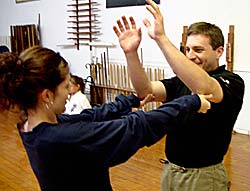
Self-defense isn’t always against someone who is trying to hurt you. Someone may grab you to control you, or maybe is just fooling around.
In these situations, and even against a real attacker, one very effective self-defense technique is also the simplest — a little pinch. Pinches don’t permanently injure, but if done effectively — wow, do they hurt. All but the most determined attacker head for the hills, or at least stop what they are doing and let go.
I began teaching this technique as part of self-defense when a student came to me a few years ago (at the State University of New York at Buffalo where I used to teach Seido karate) and asked what she could do to stop her boyfriend from testing her self-defense skills. He would playfully grab her in some hold, like a bear hug, and say, “Now, what can you do now?”
She didn’t want to hurt him, so she didn’t want attack his groin, stomp a foot, or any number of other techniques taught. Left with no tools she would just struggle. As a result, she felt frustrated and her boyfriend thought she wasn’t learning anything useful.
I taught her the pinch. “Boy did that work!” she reported back. “He tried a head lock. I just pinched his leg once — hard. He let go, jumped back and yelled at me. But he hasn’t tried anything since.”
Just any pinch, however, won’t do. You first have to know the mechanics of a pinch and how to grab the skin to make it most painful. You also have to know which areas of the body are most sensitive. Put these together and you have a real weapon.
Mechanics Of The Pinch

Most people pinch by catching skin between the tips of two fingers. The pain produced, however, is reduced by the fact that you are pressing two soft areas together — the tips of your fingers. Much more effective is to catch skin between the tip of the first finger and the hard surface of the second knuckle of the thumb.
Even more effective, but more difficult to do, is to use as a pinching mechanism the second knuckle of both the thumb and the first finger — two hard surfaces pressed together.
The skin can be pinched between these two surfaces or it can be rolled.


Here the roll and pinch is demonstrated on a sheet of paper.
Rolled is when, for example, a piece of skin is first pinched between the hard surface of the thumb’s first knuckle and the inside of the first finger. As the finger is pulled back toward the thumb’s first knuckle, the skin rolls up onto the top of the knuckle.
To get even more effect, once a pinch of skin is firmly caught, you can roll the skin sideways between your two finger surfaces. You can also twist both fingers at the same time — in an action like you are trying to twist a knob.
Do all these together and you will maximize the pain. You won’t permanently injure someone, but often a bruise appears where you have practiced this technique.
Don’t try to catch a lot of skin. The less skin, or thinner the fold of skin you catch, the more painful it can be.
The Most Effective Targets
Your pinch will be most effective in areas where the skin is naturally most sensitive. This includes:
• The inside and back of the upper arms
• The sides of the upper chest near the armpit and sides of the pectoral muscles.
• The area around a person’s nipples.
• The inside of either leg from just above the knee all the way up to the groin.
• The lob of the ear.
• The tip of the nose.
• The fold of skin between the nose and the top lip.
• The male genitals.
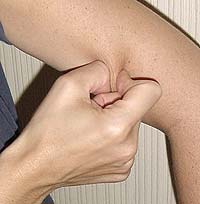 Practice your pinches carefully. Experiment to see what is most effective and where. Practice on yourself and with a partner, so you can both learn and share the pain and possibly the bruises the next day.
Remember, however, that the pinch works best on people with the most sensitive skin. Also, the effectiveness of the pinch decreases with the intensity of the situation, the presence of alcohol or other drugs and/or the determination of the attacker. So, think of the pinch as a useful tool that is helpful in a lot of situations, especially when you are trying to discourage playful fooling around attacks or against those who you do not want to harm seriously.

About the Author Christopher Caile
Screenshot
Christopher Caile is the Founder and Editor-In-Chief of FightingArts.com. He has been a student of the martial arts for over 65 years.
He first started in judo while in college. Then he added karate as a student of Phil Koeppel in 1959 studying Kempo and Wado-Ryu karate. He later added Shotokan Karate where he was promoted to brown belt and taught beginner classes. In 1960 while living in Finland, Caile introduced karate to that country and placed fourth in that nation’s first national judo tournament.
Wanting to further his karate studies, Caile then hitch hiked from Finland to Japan traveling through Scandinavia, Europe, North Africa, the Middle East and South and Southeast Asia — living on 25 cents a day and often sleeping outside.
Arriving in Japan (1962), Caile was introduced to Mas Oyama and his fledgling full contact Kyokushinkai Karate by Donn Draeger, the famous martial artist and historian. Donn also housed him with several other senior international judo practitioners. Donn became Caile’s martial arts mentor, coaching him in judo and introducing him to Shinto Muso-ryu under Takaji Shimizu.
Caile studied at Oyama’s honbu dojo and also at Kenji Kurosaki’s second Tokyo Kyokushinkai dojo. In his first day in class Oyama asked Caile to teach English to his chief instructor, Tadashi Nakamura. They have been friends ever since. Caile also participated in Oyama’s masterwork book, “This Is Karate.”
Caile left Japan with his black belt and designation as Branch Chief, the first in the US to have had extensive training in Japan directly under Oyama Sensei. As such, Oyama Sensei asked him to be his representative on visits to his US dojos to report on their status.
A little over a year later, Nakamura, Kusosaki and Akio Fujihira won an epic David vs. Goliath challenge match against Thailand’s professional Muay Thai Boxers in Bangkok, Thailand, thrusting Kyolushinkai and Nakamura into national prominence.
Back in the US Caile taught Kyokushinkai karate in Peoria, Il while in college and later in Washington, DC. while in graduate school. Durimg this time Shihan Nakamura had moved to New York City to head Kyokushinkai’s North American Operation.
In 1976 when Kaicho Tadashi Nakamura formed the World Seido Karate organization, Caile followed. Living then in Buffalo, NY, Caile taught Seido karate and self-defense at the State University of New York at Buffalo (SUNY Buffalo) for over 15 years where he also frequently lectured on martial arts and Zen in courses on Japanese culture.
Caile moved to New York City in 1999 to marry Jackie Veit. He is now an 8th degree black belt, Hanshi, training in Seido Karate’s Westchester, NY Johshin Honzan (Spiritual Center) dojo. In Seido Caile is known for his teaching of and seminars on kata applications. He also produced a 14 segment video series on Pinan kata Bunkai currently available to Seido members.
Caile is also a long-time student and Shihan in Aikido. He studied in Buffalo, under Mike Hawley Shihan, and then under Wadokai Aikido’s founder, the late Roy Suenaka (uchi deshi under Morihei Ueshiba, founder of Aikido and was Shihan under Tohei Sensei). In karate, Suenaka (8thdan) was also an in-house student of the Okinawan karate master Hohan Soken.
Having moved to New York City, Caile in 2000 founded this martial arts educational website, FightingArts.com. Twenty-five years later, in 2025, it underwent a major update and revision.
For FightingArts.com and other publications Caile wrote hundreds of articles on karate, martial arts, Japanese art, Chinese Medicine and edited a book on Zen. He also developed relationships with a cross section of leading martial arts teachers. Over the last four decades he has conducted extensive private research into karate and martial arts including private translations of the once secret Okinawan hand copied and passed on Kung Fu book, the Bubishi, as well as an early karate book by the karate master Kenwa Mabuni. He periodically returns to Japan and Okinawa to continue his studies and participate Seido karate events. In Tokyo he practiced (with Roy Suenaka Sensei) in a variety of aikido organizations with their founders – including private interviews and practices at the Aiki-kai Aikido Honbu dojo with the son and grandson of aikido’s founder, Doshu (headmaster) Kisshomaru (an old uchi-deshi friend) and his son, Moriteru Ueshiba and in Iwama with Morihiro Saito. On Okinawa he studied Goju Ryu karate under Eiichi Miyazato, 10th dan founder of Naha’s Jundokan, and also with Yoshitaka Taira (who later formed his own organization, who specialized in kata Bunkai. While there Caile also trained with Hohan Soken’s senior student, Master Fusei Kise, 10 dan as well as with the grandson of the legendary karate master Anko Itosu.
Caile’s other martial arts experience includes: Diato-ryu Aikijujitsu and Kenjitsu, kobudo, boxing, Muay Thai, MMA, Kali (empty hand, knife and bolo), study of old Okinawan Shoran-ryu & Tomari body mechanics, study of old Okinawan kata under Richard Kim, study of close quarter defense and combat, including knife and gun defenses, Kyusho Jitsu and several Chinese fighting arts including 8 Star Praying Mantis, Pak Mei (White Eyebrow), and a private family system of Kung Fu.
Caile is also a student of Zen as well as a long-term student of one branch of Traditional Chinese Medicine, Chi Kung (Qigong). As one of two senior disciples of Chi Kung master Dr. Shen (M.D., Ph.D.) Caile was certified to teach and practice. This led to Caile’s founding of the The Chi Kung Healing Institute on Grand Island, NY. In Western NY, he also frequently held Chi Kung seminars, including at SUNY Buffalo and at the famous Chautauqua Institution in Chautauqua, NY. His articles on Chi Kung also appeared in the Holistic Health Journal and in several books on alternative medicine.
Caile holds a BA in International Studies from Bradley University and MA in International Relations with a specialty in South and Southeast Asia from American University in Washington, D.C. While in Buffalo, NY he also studied digital and analog electronics.
In his professional life Caile also worked in public relations and as a newspaper reporter and photographer. Earlier he worked in the field of telecommunications including Managing a Buffalo, NY sales and service branch for ITT. He then founded his own private telephone company. This was followed by creation of an electrical engineering company that designed and patented his concept for a new type of low-cost small business telephone system (which was eventually sold to Bell South). The company also did contract work for Kodak and the US space program. Simultaneously Caile designed and manufactured a unique break-apart portable pontoon boat.
Most recently Caile co-founded an internet software company. Its products include software suites with AI capability for control and management of streaming media, such as video and music, an all-in-one book publishing software product for hardcover, eBook and audio book creation and security software for buildings and government use.
For more details about Christopher Caile’s martial arts, work experience and life profile, see the About section in the footer of this site.
Search for more articles by this author: