The Most Powerful Armlock in Judo:
Jujigatame – The Cross Armlock
By Neil Ohlenkamp
Editor’s Note: For all those martial artists who are not judo practitioners, but who understand the importance of cross training, this is an important technique. If you ever find yourself on the ground with a grappler, even if you don’t apply this technique yourself, you should understand the how, where and when of this technique, as others might try to exercise this armlock on you. Thus, understanding the cross armlock is a basic form of self-defense.
The Kodokan Judo technique Ude Hishigi Juji Gatame is commonly called jujigatame, or cross armlock. It gets its name from the position of the person doing the technique (tori) across the opponent’s body. It is one of the most effective armlocks in judo, and it is consistently the number one winning armlock used in international judo competition. It is equally effective when used for self-defense, and the technique is included in many modern and traditional jujutsu systems. It is particularly powerful because tori uses the entire body, including the strength of the legs and hips, to control the person receiving the technique (uke) and to apply tremendous pressure to the straightened arm. For this reason it can be done against much larger or stronger opponents without difficulty. For the same reason it is also potentially dangerous and should only be practiced with proper safety precautions and instruction.
There are many variations of jujigatame done from different positions and angles, and numerous entries to the armlock from various opportunities. These include variations done from the back when uke is approaching from between the legs, turnovers from the hands and knees position, and the flying jujigatame done from the standing position. The basic version shown below was included in the kata of Kodokan Judo grappling techniques (katame-no-kata) by the founder of judo, Jigoro Kano. It is shown below by Neil Ohlenkamp, rokudan, on Jerrod Wilson, sankyu.
1. Beginning in the most common position gained after completing a successful throw (sweep, or a strike in karate, taekwondo or kung fu), tori drops his right knee onto uke to begin controlling him and to prevent him from turning towards tori. The left knee can also be used for this purpose on the head. Both hands control uke’s arm with one forearm placed on uke’s elbow.
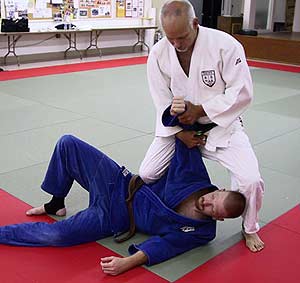
2. Tori begins to get better control of uke’s arm by squatting, and pulling uke’s elbow tightly onto tori’s stomach or chest. Tori also places his left foot over uke’s head so that uke will not be able to sit up.
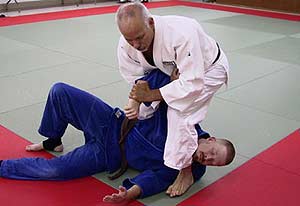
3. Tori sits down very close to uke’s shoulder so that uke’s arm is still controlled by tori’s body. Uke’s elbow must be on tori’s abdomen in the final position, so sitting close under the elbow is essential. Tori pulls uke’s elbow strongly with his right forearm.
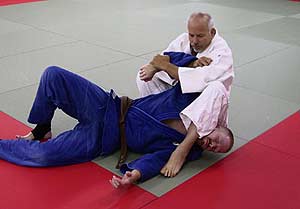
4. Tori begins to lean back keeping constant pressure on uke’s arm and squeezing the knees together to control the shoulder. Using the legs, tori should be able to keep uke down even without applying the joint-lock pressure. At this point tori makes sure that uke’s thumb is pointing up so that the pressure will be applied towards the little finger side of the arm.
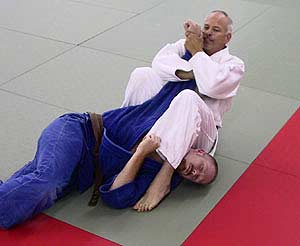
5. In the final position uke taps to submit from the pain in the elbow joint. The submission should come immediately when the arm is fully extended. For additional pressure tori can lift his hips by bridging, but this must be done slowly and carefully because it may result in dislocating the elbow.
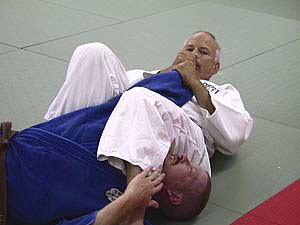
6. Tori’s hand position can vary from the standard position with both hands grabbing uke’s wrist. In this version tori has his arms crossed with the forearms controlling uke’s wrist. This is useful when uke is fighting the arm extension and tori needs to use the power of his body to pull.
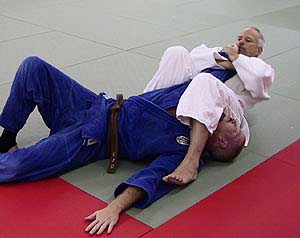
7. Another common version of this technique is done with both legs placed over uke to further limit his ability to roll up onto tori.
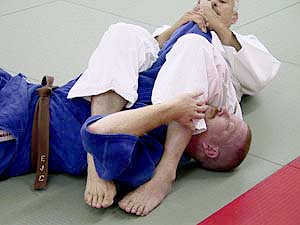
8. A strong variation is to cross the right foot over the left and to pull in with the feet. This will help to control uke’s left arm, and to prevent uke from pushing tori’s left leg off his head in an escape attempt.
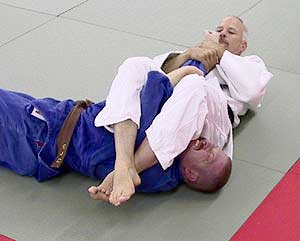
There are many opportunities for applying this armbar while grappling, but the key is always to control the opponent’s body, and particularly the elbow, throughout the application of jujigatame.
Copyright © 2004 by Neil Ohlenkamp, JudoInfo.com, USA & FightingArts.com.
Posted with permission of Neil Ohlenkamp and JudoInfo.com
Neil Ohlenkamp
Neil Ohlenkamp
Member – US Ju-Jitsu Masters Caucus
California USJJF Regional Representative
Mr. Ohlenkamp holds a sixth degree black belt in Judo and a sixth degree black belt in jujitsu with over 36 years of training and experience in various martial arts as a competitor, instructor, team coach, and tournament official. He has been awarded black belt rank certificates by the United States Judo Association, United States Judo Federation, Southern California Black Belt Association (Nanka Yudanshakai), United States Martial Arts Federation, United States Ju-Jitsu Federation, and the Kodokan Judo Institute in Tokyo, Japan. He is an active member of these organizations as well as United States Judo Inc. and the International Judo Coaches Alliance.
Mr. Ohlenkamp has been teaching martial arts for twenty five years, and has been the head instructor of the Encino Judo Club since 1985 responsible for classes in four locations teaching over 350 students each year, with the help of 25 other black belt members of the Encino Judo Club. He has developed highly successful Judo, jujitsu and self defense programs for various health clubs, churches, schools, employee groups, community centers, youth centers, and recreation centers throughout Southern California. He has trained athletes and coaches in seminars and clinics at the Olympic Training Center in Colorado Springs as well as other cities in the US and Europe. He has trained national champions as well as recreational Judo players. He is widely recognized as a leader in the teaching and promotion of Judo and jujitsu for sport and self defense.
Mr. Ohlenkamp has been a coach and advisor to the Braille Institute of America Judo Team since 1976. Due to the success of the local Judo program, he led the way in creating a national Judo program for blind athletes, and served many years as head national coach and coordinator for the U.S. Association for Blind Athletes. He was the U.S. Team Coach at the 1988 Paralympics in Seoul, Korea, the 1989 World Championships in Manchester, England, and the 1990 World Championships and Games for the Disabled in Assen, Netherlands. Coordinator of numerous elite athlete training camps, national and local tournaments, and other training opportunities for the visually impaired. He has trained many blind national and international champions, as well as other coaches and instructors. He also served as the US Representative to the International Blind Sports Association Judo Technical Committee from 1988 to 1993 and was instrumental in creating the international rules for visually impaired competitors.
Mr. Ohlenkamp has been certified by the United States Judo Association as an instructor, referee, master coach, and master rank examiner. Certified by the American Coaching Effectiveness Program and the International Blind Sports
Association, with standard Red Cross first aid and CPR certification. He earned a Bachelor’s Degree in Child Development with a specialty in recreation from California State University, Northridge and has completed post- graduate studies in Public Administration.
As a pioneer in promoting martial arts around the world through the internet, Mr. Ohlenkamp created one of the first web pages devoted to Judo. Since 1995 his Judo Information Site has been the most highly acclaimed, most popular, and most comprehensive Judo web site on the internet. He has also contributed to martial arts books, and had articles published in most of the major Judo publications in the US.
Search for more articles by this author: