
The Study of Kuzushi
By Neil Ohlenkamp
I was teaching my Judo class the other day, and I tried to explain the principal of kuzushi, or breaking balance. The reason I was explaining kuzushi is because during practice that evening most of the students were focusing on how to get their bodies into the proper position to apply the technique we were studying. Very little attention was being focused on placing the partner’s body into the proper position. As I explained the importance of breaking the opponent’s balance I could see that everyone understood that it is easier to knock down another person when he or she is off-balance. In fact I’ve noticed that is quite common for the principles of Judo to be understood long before they can be applied effectively. It is obvious, even to someone who has never studied Judo, that a throw will be more effective and require less strength when applied to an opponent who is in a weakened state of balance.
© 1992 Oscar Ratti
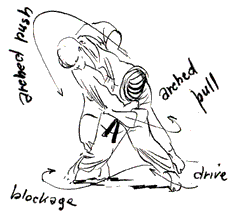
In this classical example of kuzushi being applied for the throw taiotoshi, tori’s hands bring uke into a state of unbalance while tori remains in a strong, stable position ready to apply the throwing action.

© 1992 Oscar Ratti
From this position very little strength or energy is required for tori to complete the throw. Taiotoshi is classified by the Kodokan as a hand throw and it is easy to see how the hands pull uke off balance. Additional power is brought to the kuzushi during the pivoting action (taisabaki) as tori gets into position for the throw.
One of the things that distinguishes a beginner from a more advanced student is the ability to focus attention on your opponent’s balance. It is one of the differences between learning a throw, and being able to effectively apply a throw. Many martial artists tell me that they know how to do basic Judo throws like seoinage (one arm shoulder throw) or osotogari (leg outer reaping throw) for example. However, learning to get your body into the proper position to effectively apply your strength is only part of learning a Judo throw. The real trick to making Judo techniques work easily is to find a way to catch your opponent off-balance or to force your opponent off-balance.
Most people do a fine job of getting off-balance by themselves. One way to apply Judo throws is simply to catch the opponent at every opportunity that he or she gives you. It is just not possible to move without some degree of imbalance. It is certainly not easy for your opponent to attack you without a force and movement that makes him or her vulnerable to your counter attack. However learning to take advantage of your opponent’s imbalance requires a finely tuned sense of timing. In order to be at the right place at the right time, you generally have to anticipate the opponent’s movements, a skill that requires a great deal of experience.
Another way to apply kuzushi is to set up or force your opponent into a weak position. There are many ways of moving that will result in your opponent responding in a predictable way so that you can anticipate it and take advantage of it. It can be as simple as stepping forward and pushing on your opponent, which usually results in the opponent stepping back, bracing, and pushing back. This in turn gives you the opportunity to throw them forward in the direction of their push. The most common way to force your opponent off-balance is to use combination throws, where the first throw attempted puts the opponent into an unstable position so that a subsequent attack can be successful.
Kuzushi is very often thought of as simply pushing or pulling. At more advanced levels however it is much more than that. For example, kuzushi can also be achieved by breaking the opponent’s rhythm, fake attacks, strikes, changes of body position or grip, kiai (a shout), or a sudden change in speed or tempo. A critical element in kuzushi is that it should disrupt more than the body. Kuzushi is very much a mental thing. Kuzushi should always disrupt the opponent’s concentration, resulting in a momentary opportunity for an attack. This is one of the reasons confidence is such an important factor in Judo. A strong and positive mental attitude can often dominate a weaker state of mind, resulting in effective kuzushi.
Regardless of the physical size and strength of the opponent, kuzushi will always make a throw work more efficiently. Of course the same principle applies to any technique, including grappling techniques such as chokes and joint locks. Jigoro Kano, the founder of Judo, made the principle of kuzushi one of the fundamental elements of Judo, distinguishing it from old schools of jujitsu. The principle of kuzushi is still considered to be one of his major contributions to the study of martial arts. Don’t neglect it in your study of Judo.
“The Study of Kuzushi” is copyright © 2000 by Neil Ohlenkamp, JudoInfo.com, California, USA. All rights reserved. Published August 1, 2000. Reproduced with permission.
Drawings by Oscar Ratti – Reproduced with permission of the artist.
Neil Ohlenkamp
Neil Ohlenkamp
Member – US Ju-Jitsu Masters Caucus
California USJJF Regional Representative
Mr. Ohlenkamp holds a sixth degree black belt in Judo and a sixth degree black belt in jujitsu with over 36 years of training and experience in various martial arts as a competitor, instructor, team coach, and tournament official. He has been awarded black belt rank certificates by the United States Judo Association, United States Judo Federation, Southern California Black Belt Association (Nanka Yudanshakai), United States Martial Arts Federation, United States Ju-Jitsu Federation, and the Kodokan Judo Institute in Tokyo, Japan. He is an active member of these organizations as well as United States Judo Inc. and the International Judo Coaches Alliance.
Mr. Ohlenkamp has been teaching martial arts for twenty five years, and has been the head instructor of the Encino Judo Club since 1985 responsible for classes in four locations teaching over 350 students each year, with the help of 25 other black belt members of the Encino Judo Club. He has developed highly successful Judo, jujitsu and self defense programs for various health clubs, churches, schools, employee groups, community centers, youth centers, and recreation centers throughout Southern California. He has trained athletes and coaches in seminars and clinics at the Olympic Training Center in Colorado Springs as well as other cities in the US and Europe. He has trained national champions as well as recreational Judo players. He is widely recognized as a leader in the teaching and promotion of Judo and jujitsu for sport and self defense.
Mr. Ohlenkamp has been a coach and advisor to the Braille Institute of America Judo Team since 1976. Due to the success of the local Judo program, he led the way in creating a national Judo program for blind athletes, and served many years as head national coach and coordinator for the U.S. Association for Blind Athletes. He was the U.S. Team Coach at the 1988 Paralympics in Seoul, Korea, the 1989 World Championships in Manchester, England, and the 1990 World Championships and Games for the Disabled in Assen, Netherlands. Coordinator of numerous elite athlete training camps, national and local tournaments, and other training opportunities for the visually impaired. He has trained many blind national and international champions, as well as other coaches and instructors. He also served as the US Representative to the International Blind Sports Association Judo Technical Committee from 1988 to 1993 and was instrumental in creating the international rules for visually impaired competitors.
Mr. Ohlenkamp has been certified by the United States Judo Association as an instructor, referee, master coach, and master rank examiner. Certified by the American Coaching Effectiveness Program and the International Blind Sports
Association, with standard Red Cross first aid and CPR certification. He earned a Bachelor’s Degree in Child Development with a specialty in recreation from California State University, Northridge and has completed post- graduate studies in Public Administration.
As a pioneer in promoting martial arts around the world through the internet, Mr. Ohlenkamp created one of the first web pages devoted to Judo. Since 1995 his Judo Information Site has been the most highly acclaimed, most popular, and most comprehensive Judo web site on the internet. He has also contributed to martial arts books, and had articles published in most of the major Judo publications in the US.
Search for more articles by this author: