The Voice Of Authority – Part 2
Tactical Communications Training
By Christopher Caile
Editor’s Note: This is the second in a three part series on NYPD’s Tactical Communications Training. Part 1 discussed inception of the program and its goals. Part 2 focuses on training while Part 3 provides an overview of the programs concepts and principles.

Detective James Shanahan, a senior instructor in Tactical Communication makes a point to a class of recruits undergoing training at the New York Police Academy.
Detective James Shanahan, a senior instructor of the New York City Police Academy, is an ideal teacher. An accomplished, decorated veteran for over 26 years, he knows the streets. He also knows how to communicate his message. He’s bald, and six foot three and looks a like a mix of a jovial Santa Claus and Mr. Clean. Dynamic and charismatic, he speaks with a bigger than life personality. The smile he projects is disarming.
His unit is charged with training all new NYPD recruits in the basics of effective communications and conflict resolution that can help them in their daily duties. This covers a lot of ground and a lot of police officers and recruits. There are nearly 1000 recruits currently undergoing training at the Police Academy as well as approximately 35,000 active officers.
Unlike the NYPD, most people are not trained in communication skills. Martial artists are different. Traditional arts stress self-discipline in mind and body, practice traditional etiquette and follow protocols of behavior within an environment that stresses mutual respect – components that comprise many of the same human skills taught to officers in Tactical Communications.
The program is a comprehensive mix boiled down for easy digestion. Included are people skills, conflict resolution, and psychology as well as communication theory and strategy. Originally based on the ground-breaking work of Dr. George Thompson, a former professor of literature and Judo black belt, turned police officer. The program has been expanded from Thompson’s curriculum to include additional psychology, persuasion strategies and insights from eastern philosophy.
All recruits are given this basic training. But teaching existing officers, detectives and even supervisors can be more daunting. They can be a hard-nosed bunch, ingrained with their own ideas of procedure. They also don’t take well to dry lectures, or unsolicited advice and may have their own ideas of what works.
In short, the challenge arises from teaching people with different personalities, cultural backgrounds, histories and temperament. That is a difficult job, but also important.
The basics include many skills and tactics, which could be characterized as “common sense.” But as Mark Twain once said, “Common sense is very uncommon.” What can be easily understood is often difficult to put into practice when there is ego, emotion and other factors involved.
Shanahan’s classes are not dry. Instead of lectures he uses his skills as a part time actor to enliven his discussion with situational enactments, role-playing and video presentations. Various situations which officers often face become alive as he acts out situations, taking on roles for his audience of different personality types. Students are constantly challenged to give their opinions and asked to examine their judgments. There are also summary outlines that are filled in by students as they progress through training. This keeps things lively and gives the feeling of participation in actual situations.
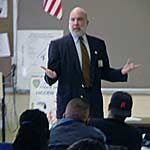
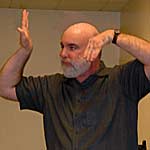


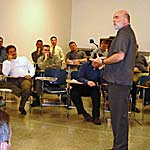
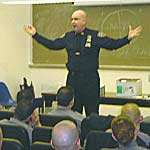
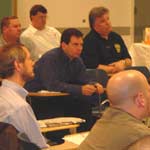
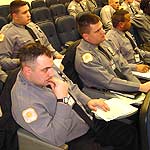
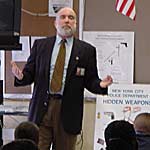
Shanahan role-plays, uses instructional videos, charts out verbal strategies on the black board, talks out ideas and asks questions to prompts his students into active participation in Tactical Communications training.
“Police ‘In Service’ audiences can be tough,” says Shanahan. “I use this course to teach my class”. He explains. “No cop is going to stand for a sermon on ‘being nice’.” He refers to his teaching style as “enter-trainment” and describes it as the nexus between training and entertainment. “If you are too much the entertainer, you can diminish the value of your work and be seen as merely a stand up comic. If you take yourself too seriously and are too heavy with the training, you risk being defined as pedantic, full of yourself, a ‘by the book phony’. Many cops I teach are struggling and need help. Yet, they are smart and have great instincts. You need to speak with them, for them, not at them. In order to be successful, your credibility and creativity better match. If not, you’re in trouble.”
This type of training works because it lets officers and recruits see their own strengths and weakness in conduct and communications. It helps them recognize what is effective, and what is not. Officers can learn to understand how their actions and words can either reduce the potential for physical violence or escalate it.
A wide variety of situations are covered. Traffic stops, interactions with citizens in various street situations, and confrontations are examined, rehearsed and broken down for analysis – students given an active role in the training. The curriculum covers psychology, personal assessment, and strategies for working with different types of personalities. Professionalism is stressed, including both dress and attitude. Methods of non-confrontational tactics are taught — all grounded in basic communication skills and strategies.
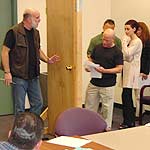
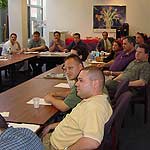
Shanahan, who also serves as a trainer in hostage negotiations in addition to be a Senior Trainer in Tactical Communications, plays an intransigent citizen in a hostage negotiation role-playing exercise with several students in a class in Hostage Negotiation conducted in conjunction with the detective bureau of the New York City Police Department. Training in Hostage Negotiation includes many of the same principles and strategies of communication as are taught in classes in Tactical Communications.
In short, Tactical Communications teaches how to resolve situations where compliance is needed without force. The officer presents a confident and professional presence, is non-emotional and uses a proper choice of words, avoiding use of insults or derogatory behavior. This strategy is successful in vast majority of interactions with the public.
When words fail, however, or when actions or the situation calls for an immediate forceful response, other measures are taken. Tactical Communication is but one step along a continuum, which includes various levels of defensive force – use of mace, impact weapons, firearms, etc. The goal, however, is to avoid these escalations whenever possible.
In the first Tactical Communication class I attended, a video was shown of a State Trooper’s interaction with a driver of a vehicle he had pulled over. The driver’s reaction was very emotional and full of expletives.
The class was asked to comment on how the State Trooper handled the traffic stop in terms of composure, his professionalism and verbal control of the situation. The situation was then discussed in detail and lessons drawn from it.
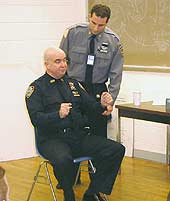
Before a class of police officers Shanahan role-plays with student officers in a mock traffic stop. Shanahan acts out various verbal responses, emotional reactions, and problems drivers often present officers when they pull over drivers. Officers in turn to use a simple structured dialogue designed to maintain control and exert authority that if employed can avoid many of the problems and responses often encountered.
Of course traffic stops are a sort of unique situation requiring both officer control and driver response. To help officers a simple word formula was suggested– a series of statements to be used in traffic stops. Taken together these sentences provided a short hand method to professionally and effectively execute a traffic stop – a method to maintain control and elicit driver responses. The objective was to teach officers how to verbally engage a driver to minimize potential conflict or verbal abuse, to allow inspection of a license, and registration and issue a ticket or make an arrest.
Officers and recruits then role-played with each other to employ the suggested wording. With practice the method becomes ingrained and natural.
So how effective is the program? One of the officers in the course commented, “The course makes a lot of sense, it is something I can use. It is learning how to communicate, so you can communicate in a way others can easily understand and accept what you are saying and asking them to do.”
In mid-town New York, I asked one police officer on the street what he thought about the training. Asking that his name not be used, he said he found Tactical Communications very useful. “It’s another tool in our tool bag,“ he said. “It took a little re-training for me, but now I find it can be effective. I have found that it makes dealing with the public smoother and often easier.”
Talking to a variety of other cops on the streets in various boroughs of NYC, there were similar reactions. Several cops complimented the program and one officer on security duty at one of the bridges leading to Manhattan cited back to this writer the exact verbal strategy most often used when dealing with civilian compliance.
Another cop on traffic duty in the Bronx, however, said he couldn’t remember much about the program. “It was over four years ago,” he said. This comment underscores the difficulty of teaching such a large force and the need for periodic retraining.

About the Author Christopher Caile
Screenshot
Christopher Caile is the Founder and Editor-In-Chief of FightingArts.com. He has been a student of the martial arts for over 65 years.
He first started in judo while in college. Then he added karate as a student of Phil Koeppel in 1959 studying Kempo and Wado-Ryu karate. He later added Shotokan Karate where he was promoted to brown belt and taught beginner classes. In 1960 while living in Finland, Caile introduced karate to that country and placed fourth in that nation’s first national judo tournament.
Wanting to further his karate studies, Caile then hitch hiked from Finland to Japan traveling through Scandinavia, Europe, North Africa, the Middle East and South and Southeast Asia — living on 25 cents a day and often sleeping outside.
Arriving in Japan (1962), Caile was introduced to Mas Oyama and his fledgling full contact Kyokushinkai Karate by Donn Draeger, the famous martial artist and historian. Donn also housed him with several other senior international judo practitioners. Donn became Caile’s martial arts mentor, coaching him in judo and introducing him to Shinto Muso-ryu under Takaji Shimizu.
Caile studied at Oyama’s honbu dojo and also at Kenji Kurosaki’s second Tokyo Kyokushinkai dojo. In his first day in class Oyama asked Caile to teach English to his chief instructor, Tadashi Nakamura. They have been friends ever since. Caile also participated in Oyama’s masterwork book, “This Is Karate.”
Caile left Japan with his black belt and designation as Branch Chief, the first in the US to have had extensive training in Japan directly under Oyama Sensei. As such, Oyama Sensei asked him to be his representative on visits to his US dojos to report on their status.
A little over a year later, Nakamura, Kusosaki and Akio Fujihira won an epic David vs. Goliath challenge match against Thailand’s professional Muay Thai Boxers in Bangkok, Thailand, thrusting Kyolushinkai and Nakamura into national prominence.
Back in the US Caile taught Kyokushinkai karate in Peoria, Il while in college and later in Washington, DC. while in graduate school. Durimg this time Shihan Nakamura had moved to New York City to head Kyokushinkai’s North American Operation.
In 1976 when Kaicho Tadashi Nakamura formed the World Seido Karate organization, Caile followed. Living then in Buffalo, NY, Caile taught Seido karate and self-defense at the State University of New York at Buffalo (SUNY Buffalo) for over 15 years where he also frequently lectured on martial arts and Zen in courses on Japanese culture.
Caile moved to New York City in 1999 to marry Jackie Veit. He is now an 8th degree black belt, Hanshi, training in Seido Karate’s Westchester, NY Johshin Honzan (Spiritual Center) dojo. In Seido Caile is known for his teaching of and seminars on kata applications. He also produced a 14 segment video series on Pinan kata Bunkai currently available to Seido members.
Caile is also a long-time student and Shihan in Aikido. He studied in Buffalo, under Mike Hawley Shihan, and then under Wadokai Aikido’s founder, the late Roy Suenaka (uchi deshi under Morihei Ueshiba, founder of Aikido and was Shihan under Tohei Sensei). In karate, Suenaka (8thdan) was also an in-house student of the Okinawan karate master Hohan Soken.
Having moved to New York City, Caile in 2000 founded this martial arts educational website, FightingArts.com. Twenty-five years later, in 2025, it underwent a major update and revision.
For FightingArts.com and other publications Caile wrote hundreds of articles on karate, martial arts, Japanese art, Chinese Medicine and edited a book on Zen. He also developed relationships with a cross section of leading martial arts teachers. Over the last four decades he has conducted extensive private research into karate and martial arts including private translations of the once secret Okinawan hand copied and passed on Kung Fu book, the Bubishi, as well as an early karate book by the karate master Kenwa Mabuni. He periodically returns to Japan and Okinawa to continue his studies and participate Seido karate events. In Tokyo he practiced (with Roy Suenaka Sensei) in a variety of aikido organizations with their founders – including private interviews and practices at the Aiki-kai Aikido Honbu dojo with the son and grandson of aikido’s founder, Doshu (headmaster) Kisshomaru (an old uchi-deshi friend) and his son, Moriteru Ueshiba and in Iwama with Morihiro Saito. On Okinawa he studied Goju Ryu karate under Eiichi Miyazato, 10th dan founder of Naha’s Jundokan, and also with Yoshitaka Taira (who later formed his own organization, who specialized in kata Bunkai. While there Caile also trained with Hohan Soken’s senior student, Master Fusei Kise, 10 dan as well as with the grandson of the legendary karate master Anko Itosu.
Caile’s other martial arts experience includes: Diato-ryu Aikijujitsu and Kenjitsu, kobudo, boxing, Muay Thai, MMA, Kali (empty hand, knife and bolo), study of old Okinawan Shoran-ryu & Tomari body mechanics, study of old Okinawan kata under Richard Kim, study of close quarter defense and combat, including knife and gun defenses, Kyusho Jitsu and several Chinese fighting arts including 8 Star Praying Mantis, Pak Mei (White Eyebrow), and a private family system of Kung Fu.
Caile is also a student of Zen as well as a long-term student of one branch of Traditional Chinese Medicine, Chi Kung (Qigong). As one of two senior disciples of Chi Kung master Dr. Shen (M.D., Ph.D.) Caile was certified to teach and practice. This led to Caile’s founding of the The Chi Kung Healing Institute on Grand Island, NY. In Western NY, he also frequently held Chi Kung seminars, including at SUNY Buffalo and at the famous Chautauqua Institution in Chautauqua, NY. His articles on Chi Kung also appeared in the Holistic Health Journal and in several books on alternative medicine.
Caile holds a BA in International Studies from Bradley University and MA in International Relations with a specialty in South and Southeast Asia from American University in Washington, D.C. While in Buffalo, NY he also studied digital and analog electronics.
In his professional life Caile also worked in public relations and as a newspaper reporter and photographer. Earlier he worked in the field of telecommunications including Managing a Buffalo, NY sales and service branch for ITT. He then founded his own private telephone company. This was followed by creation of an electrical engineering company that designed and patented his concept for a new type of low-cost small business telephone system (which was eventually sold to Bell South). The company also did contract work for Kodak and the US space program. Simultaneously Caile designed and manufactured a unique break-apart portable pontoon boat.
Most recently Caile co-founded an internet software company. Its products include software suites with AI capability for control and management of streaming media, such as video and music, an all-in-one book publishing software product for hardcover, eBook and audio book creation and security software for buildings and government use.
For more details about Christopher Caile’s martial arts, work experience and life profile, see the About section in the footer of this site.
Search for more articles by this author: