
Leg Circles Part 1 – Stretching the Hip Muscles for Higher Kicks
By Paul Zaichik
Editor’s Note: This is the first in a series of articles that focus on the hip joint and its muscles. Part 2 of this series will focus on extended length conditioning applied to the leg circle.
The hip joint is located right below the midsection of the body, and any force transferred into a technique must pass directly through it. Everyone from beginner to advanced athlete knows that if you can incorporate the hip into a technique, you can produce more force. In karate this translates into greater impact.
If you can isolate the movers of the hip joint from the other muscles, this allows the body to exploit degrees of freedom in the joint. Exercises which focus on isolating the hip joint also foster long lasting health and stability of the joint.
Leg circles are one of those exercises. This exercise was first introduced by Joseph Pilates. Now the leg circle has found its way into dance, martial arts and other athletic communities.
Despite looking simple and straight forward, this exercise is extremely effective for stabilization, isolation and control of the hip joint. As far as martial arts is concerned, incorporating this technique into the conditioning routine has incredible effect on the speed, power and control of kicks, not to mention injury prevention.
o begin the exercise lie down on your back with hands by your sides and both legs straight. Lift one leg toward the ceiling, press your lower back onto the floor (you want to prevent an arch in the lower back) and pull the naval toward the spine.
How low your leg will go (Picture 1) depends on your level of strength, flexibility and control. Lower your leg to the outside. Do not allow your back to shift. Keep the opposite hip on the floor. The whole movement must be in the hip joint. Abdominal muscles only stabilize the movement. (Picture 2)
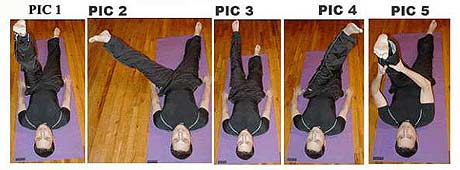
Now lower the leg and bring it parallel to the other leg. The moving leg should be a few inches away from the floor. Again try not to lift your lower back off the floor. (Picture 3)
Now bring the leg up and over the other leg. This part of the movement stretches the outside of the hamstrings. Most martial artists tend to focus on the inner hamstrings stretches, and this exercise may be a good way to bring balance to the back of the leg. As before, do not allow your back or your buttocks to come off the floor. (Picture 4)
Repeat the exercise 5-10 times on each leg. Do not forget to circle the leg in the opposite direction. The speed of the movement depends on your level of conditioning at the moment. Ideally the leg should travel at low to medium speed. This exercise loosens up the muscles surrounding the hip joints. Try stretching the hamstring gently; you may be surprised at the results. (Picture 5)

Paul Zaichik
Paul Zaichik is an athletic trainer and the author of “ElasticSteel Method of Athletic Conditioning Strength & Flexibility” as well as his latest “The Gravity Advantage” Books. His education is in Exercise Physiology and Nutrition. After training in many sports, he began his martial arts practice in 1990. He currently teaches and coaches such sports and activities as Yoga, gymnastics, dance, pilates, soccer, track and field, weight training, activity specific conditioning, and martial arts, among many others. He also helps athletes in post- rehab, using such modalities as hypnosis, nutrition, and massage. ElasticSteel method of athletic conditioning, incorporates many modalities for specific athletic needs. His website is: www.elasticsteel.com
Search for more articles by this author: