
Surviving A Multi-Opponent Attack
Part 3:
Maneuvering For Advantage: Basics
By Christopher Caile
Editor’s note: This is the third of a series of articles exploring principles, tactics and techniques that can be used when confronted with multiple attackers.
I believe that proper movement is the most critical element of defense against multiple attackers. It is also the least understood.
I see many martial arts books and videos of experts demonstrating their defenses against multiple attackers. The master stands in the center, turning this way and that to defeat each successive attacker. It’s inspiring. It makes you think if you just study his art and learn his knowledge you might someday become invincible too.
Don’t believe it. It usually doesn’t work. On the street attackers aren’t respectful, they don’t wait their turn, and they don’t keep their distance. They close in from all sides like a garbage compactor – squish.
I’m not sure if it is a lack of understanding, the difficulty of explanation, or the limitations of video, but the most important element is missing in these books and videos — that of getting out of positions of maximum danger and moving to a position of advantage.
The first part of proper movement is a basic vocabulary of stances and movement patterns that enable your action. These are the building blocks that enable you to take back some control in a multi-opponent attack that has gotten out of control.
Yin & Yang Of Action
Central to the stance and movement patterns discussed below are two counterbalancing concepts.
1 – Do Unto Others
A logical outgrowth of the two principles discussed in Part 2 of this article (Indomitable Spirit and Total Commitment) is not to be defensive, but to be offensive. That means to take the initiative whenever possible (discussed briefly in Part 1 ).
When you react defensively you cede timing and initiative to your attackers. If you wait to react, this gives time to your opponents to circle or close in on you.
A good friend, Oscar Ratti (co-author of “Aikido and The Dynamic Sphere” and “Secrets of the Samurai”), said it well when he observed: “In combat against others, always be on the offensive. Take the initiative. Don’t even think about defense. Even thinking about it slows you down. Instead, create chaos and havoc in them first. Do unto others before they do it to you.”
However, just being aggressive and attacking is not enough. You should move to maximize your position (the subject of the following article). Equally, your attacks and moves should not be so wild or foolish as to endanger you.
2 – Don’t Do It To Yourself
The flip side of attacking or taking the initiative is not to endanger yourself needlessly – the yin to temper the yang.
While there are no fixed rules in facing multi-attackers, playing the percentages always has advantage. You may get away with something that also momentarily makes you vulnerable or exposed, but too often the odds catch up with you. If you gamble and throw the dice, you may win big sometimes, but most often you lose. On the street the consequences can be more severe. So avoid rolling the dice. Here are a few cautions.
•  Be careful with kicks. Any kick momentarily freezes you on one leg and can slow forward movement. You are also less stable. If pushed or grabbed you can be unbalanced or thrown to the ground, so keep kicks fast and pull them back quickly. Also combine them with other techniques. High and spinning kicks are especially dangerous. You can sometimes get away with them but don’t make them your habit. You expose your groin and the kicking leg can be caught. The kicker also leans backward. This moves his body backward and exposes it to potential attack from behind. This is the reason that in most old karate kata the kicks were kept low (at least in the original kata versions). (1)
• Before being attacked don’t assume a defensive preparatory stance with raised arms and wait for the action to begin. Boxers or karate practitioners do this at the start of a match to be fair and let the opponent be prepared. This isn’t your goal. It wastes time and signals defense. If an attack hasn’t started, attack first and/or move to a better position.
• Don’t fight from wide horse stance (or a modified one). This can be a dangerous fighting position against multiple attackers since you are standing sideways with the legs spread. This needlessly exposes the groin to attacks not only from the front but the sides, while also exposing the back. Quick movement to the sides is also more difficult. It is also a defensive position. Your opponents see it and your own psyche knows too — two negatives when your actions have to be totally offensive. You are also not positioned for total commitment or aggressive initiative. The stance is useful in some situations, however. These will be discussed below. But keep the stance limited to special situations.
• Minimize weighting or standing on one foot. This can limit mobility and reduce stability. In multi-attacker confrontations mobility and stability are prime, thus any position that roots you on one foot should be minimized since it reduces these factors.
(a) Cat stances can be momentarily useful in some situations, but don’t stay there. You can use them as transitions, to create momentary space in one direction or a platform to kick from, but don’t linger — they are defensive and they inhibit movement.
(b) Likewise lifting the knee to block a kick is sometimes useful but it can also be dangerous. This is a favorite response of grapplers who fakes a low kick to your legs and then charge in low to take you off your feet. My housemate in Buffalo was a full-contact Ultimate Fighter and grappler who used this move to perfection against me — bang. At first, I couldn’t figure out what was happening. He would kick, I would lift my leg and there I would be flat on my back with him all over me.
Eventually I found that, against a grappler (percentage wise), it was more effective to pivot out of the way of a low roundhouse kick, pull back the front foot out of the way, or shift to the side or backward at an angle with a simultaneous down block.
(c) While punching try not to plant your forward foot. While this can be useful in delivering maximum power forward, it also roots you and shifts weight on to your forward foot. As a result, you lose mobility.
Tools of The Trade
Principles, tactics, and techniques are all good, but you have to tie them in with a strategy that can get your where you need to be and get you away from the most dangerous situations. Here we discuss the tools of the trade — the basics of standing, moving and turning. In the next section of this article we show how to put them together so you can move to a position of advantage.
Whatever happens or develops in a multiple attack you will probably start from a normal standing or walking position (sitting or lying positions are outside the scope of this series of articles). If you are walking and attacked everything is sudden and you are into it before you can think. Standing can be a little different. You have probably stopped walking or you are standing as someone approaches, or is there next to you.
A standing position has many advantages. While high, and thus less than perfectly stable, this stance enables you to move quickly in any direction and the legs are close enough together to protect the groin from many kicks, or knees. (2)
When action begins you always want to protect your head, a favorite target of attackers. A common tactic to avoid a surprise hit is to say something and talk with your hands up front between you and the closest attacker. This will not seem aggressive but will allow a split second block or a quick offensive technique since your hands should already be more than half way to your opponent. This is not a defensive stance (discussed below).
Once things start, protect your face and head as you move. You also want to keep low and have your feet under you. This also protects your groin. You can take long steps to move, but don’t keep one once you in close to an attacker. Here keep your stance narrow. Some experts suggest keeping the rear leg angled slightly outward so as to be able to quickly shift to the side. (3) I like to keep the front foot angled in slightly to give a little extra groin protection.
There are also several patterns or principles of movement you will find optimal in multi-attacker situation — the quick advance, the slide or angle past, the bump and run, the zig zag movement, and the pivot. (4)
• Move forward quickly, not backward (just like in most karate kata) so you can take a position of advantage or achieve an objective. Often this means moving into an attacker to attack, or to interrupt an attack coming at you before it has fully developed (jamming). Being close also can forestall a second attack from an opponent’s foot or other fist. In the process of moving forward you also create space behind you and thus avoid a sudden hit from behind. The diagram below represents this situation. The three circles at top represent a defender between two attackers. Both attackers can reach him. Below, the defender advances towards one attacker, thereby creating a momentary barrier of space at his back.

This doesn’t mean you can never back up — retreating can give you some momentary space, and thus protection. But if you continue backing up, you put yourself at serious risk since your attackers are probably advancing too. This means you have given up the initiative to them. In the process they might get closer, position around you or you might be maneuvered into a place that limits further retreat.
When you move forward for any distance, do so quickly. Shuffling forward like a boxer (or most martial arts competitors) is great for small adjustments, but too slow over more than a few feet. So if you want to move more than a single step take strides, one foot in front of another similar to the way you move in kata. And it helps to keep low and centered so you can punch or block, grab or control. (5)
• An important corollary of the quick advance is to angle past an opponent, or if a tight place, to slide around him.
Forward movement if angled can get you to the side or behind the opponent — a space where his weapons can’t get at you and from where you can more easily control, throw or take down your opponent. This is shown in the two drawings below. At left, an attacker is preparing to club the defender. The blow is avoided, however, by stepping forward and angling to the side of the opponent (right drawing).
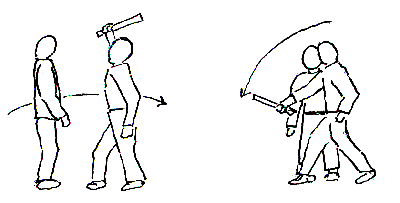
When is a tight place, such as in a corner with an attacker close, it is useful to slide your forward foot at an angle past your opponents front foot and sink into a low stable position (horse stance) at his side. My boxing coach often demonstrated this type of quick slide around the edge of an opponent who was trying to corner you in the ropes. As part of this move he used his forward arm like a windshield wiper (outside block fashion) against the rear of an opponent’s shoulder to help propel himself around to the outside.
• The bump and run is a second corollary of the quick advance. This is when you move forward quickly to freeze or make your opponent move backward.
Sometimes you don’t actually have to make contact. Just a quick threatening forward move can freeze someone or force a quick retreat so you can get around them. Another scenario is when one attacker is standing close right in front of others. Here a quick forceful push, bump, or kick forces the attacker backward. Because others are standing right behind, there is little or no room to step back. Legs will get tied up. The front attacker will often stumble, or at least take a second to regain balance. Other attackers standing behind him will also be momentarily blocked. (6) This can buy you room to maneuver as well as precious time.
• Zig Zaging is like broken field running in football. Moving one direction and then quickly veering off in another to avoid opponents, or to make space. Examples discussed in the next installment of this article will illustrate this movement.
• Pivoting and turning. Quick pivoting motions can quickly get you out of the path of an attack or away from an attacker. Think like a basketball player who quickly pivots so he can shoot. In one-on-one situations the defender often parries/deflects while:
(a) Pivoting back –Moving one leg back and to the side while narrowing the body — a sort of opening the door to let an attack or an attacker pass by.
(b) Pivoting away – Pivoting 90 degrees or 180 degrees on the forward foot to get to the side of an opponent or an attack, or to move to position of advantage to the side.
(c) Pivoting or turning in order to control and lead an attack or attacker’s body or to throw or take down an opponent. Also to control the energy of multiple grabbers.
(d) Pivoting to slide or move past an opponent who is crowding you.
(e) Spinning when attacked to deflect strikes or kicks.
In the next installment of this series we will discuss putting your tools, strategy and tactics together as part of various movement strategies.
Footnotes:
(1) This can be a confusing point. Many people would say, “but even in many of the old kata people kick high.” That is true, but people now perform kata to look good, to demonstrate their physical capability and to impress judges. This wasn’t always so. The kata has also been changed. For example, let’s look at Pinan #4 . This same technique is also part of the much older kata Kanku (also known as Kusanku in Okinawa). In Pinan #4 the practitioner kicks to the side with the blade of his foot (side kick) accompanied with a back fist that rises from the waist level vertically and moves in a half circle to strike with two knuckles (furi-uchi). This is done to both sides. In the oldest versions of the kata, this technique was different. Instead there was a body pivot to the side and a simultaneous middle level front kick and strike with the arm traveling from the waist in a horizontal circular path and striking with the little finger side of a clenched fist (tettsui). When the Pinan kata was taken to Japan as part of karate things changed (even the name Pinan was changed in many styles to Heian). Sometime in the late 1930’s this technique also changed. When I first learned the kata in the late 1950’s in the United States (studying a mixture of Kempo and Shotokan karate), the side kick and back fist were done very quickly, the side kick whipped out (to midsection or chest level) and pulled back so the technique could progress into an elbow smash (the next technique). Everything was done very fast. It was done the same way in Japan in Kyokushin karate in the early 1960’s. Sometime by the late 1970’s or early 1980’s the technique styles changed again in some styles (I was then studying Seido Karate). Now the side kick was no longer whipped out and retreated. Instead the side kick was thrust out and held for a moment. It looked great and competition judges loved it. Some practitioners could kick high above their head and hold the extended kick position. A lot of kata competitions were won with this type of gymnastic flexibility. This execution, however, is far cry from the original technique and further divorced from functional execution. It should be stated, however, that many styles still practice versions of Pinan #4 and Kanku (Kusanku) using the original technique with the front kick aimed at a low target.
(2) This is the reason that almost all karate kata start from this position, a natural stance from which a defender can easily move in any direction, pivot or turn to the side, drop down or move using a variety of stances.
(3) In aikido, for example the back foot it often angled 90 degrees to the side. This way the body is able to quickly move to the side. If the back foot is angled forward, movement to the side can be slightly slowed because most people will turn their foot slightly before moving and this takes time. Interestingly, in some karate styles, some stances also employ the back foot at 90 degrees to the side, or even turned to the rear. This is related to footnote #4 (directly below).
(4) I have not discussed here a concept of movement that can reduce response time and add speed (of movement) over short distances. It was unique among the Samurai and was one distinct element that provided his edge, and enabled almost unbelievable feats — that of dropping your weight into steps instead of moving it forward as most everyone does while stepping. But the topic was avoided here because it is so foreign and difficult to master. It requires a re-education of movement. It has also been lost to most modern martial arts. You still see it in a few old styles of karate and in such arts, as daito-ryu aikijujutsu, and swordsmanship (kenjutsu). Other arts, such as aikido, employ the same concepts in some movement, but not in others.
(5) A karate practitioner (as well as taekwondo and kung fu) here might think of using front leaning stances, while aikido and jujutsu practitioners might be a little higher, taking one quick large step or two alternate steps forward just like in practice. This is striding, not running. It is more controlled and your arms are free to punch or do other techniques. You can also change direction, or pivot, or pull back one foot (cat stance) to create a little space in front of you and/or to kick. The body can be turned to the side (short horse stance) to evade or move to the side.
One of the fastest forward movement over distance (10-15 feet or more) I have ever seen is the stance and movement seen in many kata, such as Pinan One, where there are three explosive steps with punches. Shotokan karate stylists often use this type of quick stepping to close in on competitors. Likewise some Chinese kung fu systems, especially pak mei (white eyebrow), moves this way with incredible, almost overpowering speed while punching.
(6) An good example of this type tripping was seen in a demonstration. In the early 1970’s one day I accompanied Shihan Tadashi Nakamura (then head of the Kyokushin’s North American Organization) to Madison Square Garden where he was to give a demonstration of karate. Appearing just after him was Bruce Lee, who demonstrated his one inch punch. He lined up five or six people right in front of each other and put a chair just behind the last person in line. Standing in front, he then punched the first man, who fell into the second, who fell into the next until the last man fell into the chair and tipped backward. It looked amazing but in reality everyone was set up to easily trip over the next, so it was difficult to really judge the amount of power generated. In contrast, Nakamura demonstrated breaking through four one inch boards (without spacers) held by an associate using just his fingertips (nukite).
Part 1: Interfering With And Avoiding An Impending Attack
Part 2: Principles & Tactics
Part 3: Maneuvering For Advantage: Basics
Part 4: Maneuvering For Advantage: Putting It All Together
Part 5: Maneuvering For Advantage: More Scenarios

About the Author Christopher Caile
Screenshot
Christopher Caile is the Founder and Editor-In-Chief of FightingArts.com. He has been a student of the martial arts for over 65 years.
He first started in judo while in college. Then he added karate as a student of Phil Koeppel in 1959 studying Kempo and Wado-Ryu karate. He later added Shotokan Karate where he was promoted to brown belt and taught beginner classes. In 1960 while living in Finland, Caile introduced karate to that country and placed fourth in that nation’s first national judo tournament.
Wanting to further his karate studies, Caile then hitch hiked from Finland to Japan traveling through Scandinavia, Europe, North Africa, the Middle East and South and Southeast Asia — living on 25 cents a day and often sleeping outside.
Arriving in Japan (1962), Caile was introduced to Mas Oyama and his fledgling full contact Kyokushinkai Karate by Donn Draeger, the famous martial artist and historian. Donn also housed him with several other senior international judo practitioners. Donn became Caile’s martial arts mentor, coaching him in judo and introducing him to Shinto Muso-ryu under Takaji Shimizu.
Caile studied at Oyama’s honbu dojo and also at Kenji Kurosaki’s second Tokyo Kyokushinkai dojo. In his first day in class Oyama asked Caile to teach English to his chief instructor, Tadashi Nakamura. They have been friends ever since. Caile also participated in Oyama’s masterwork book, “This Is Karate.”
Caile left Japan with his black belt and designation as Branch Chief, the first in the US to have had extensive training in Japan directly under Oyama Sensei. As such, Oyama Sensei asked him to be his representative on visits to his US dojos to report on their status.
A little over a year later, Nakamura, Kusosaki and Akio Fujihira won an epic David vs. Goliath challenge match against Thailand’s professional Muay Thai Boxers in Bangkok, Thailand, thrusting Kyolushinkai and Nakamura into national prominence.
Back in the US Caile taught Kyokushinkai karate in Peoria, Il while in college and later in Washington, DC. while in graduate school. Durimg this time Shihan Nakamura had moved to New York City to head Kyokushinkai’s North American Operation.
In 1976 when Kaicho Tadashi Nakamura formed the World Seido Karate organization, Caile followed. Living then in Buffalo, NY, Caile taught Seido karate and self-defense at the State University of New York at Buffalo (SUNY Buffalo) for over 15 years where he also frequently lectured on martial arts and Zen in courses on Japanese culture.
Caile moved to New York City in 1999 to marry Jackie Veit. He is now an 8th degree black belt, Hanshi, training in Seido Karate’s Westchester, NY Johshin Honzan (Spiritual Center) dojo. In Seido Caile is known for his teaching of and seminars on kata applications. He also produced a 14 segment video series on Pinan kata Bunkai currently available to Seido members.
Caile is also a long-time student and Shihan in Aikido. He studied in Buffalo, under Mike Hawley Shihan, and then under Wadokai Aikido’s founder, the late Roy Suenaka (uchi deshi under Morihei Ueshiba, founder of Aikido and was Shihan under Tohei Sensei). In karate, Suenaka (8thdan) was also an in-house student of the Okinawan karate master Hohan Soken.
Having moved to New York City, Caile in 2000 founded this martial arts educational website, FightingArts.com. Twenty-five years later, in 2025, it underwent a major update and revision.
For FightingArts.com and other publications Caile wrote hundreds of articles on karate, martial arts, Japanese art, Chinese Medicine and edited a book on Zen. He also developed relationships with a cross section of leading martial arts teachers. Over the last four decades he has conducted extensive private research into karate and martial arts including private translations of the once secret Okinawan hand copied and passed on Kung Fu book, the Bubishi, as well as an early karate book by the karate master Kenwa Mabuni. He periodically returns to Japan and Okinawa to continue his studies and participate Seido karate events. In Tokyo he practiced (with Roy Suenaka Sensei) in a variety of aikido organizations with their founders – including private interviews and practices at the Aiki-kai Aikido Honbu dojo with the son and grandson of aikido’s founder, Doshu (headmaster) Kisshomaru (an old uchi-deshi friend) and his son, Moriteru Ueshiba and in Iwama with Morihiro Saito. On Okinawa he studied Goju Ryu karate under Eiichi Miyazato, 10th dan founder of Naha’s Jundokan, and also with Yoshitaka Taira (who later formed his own organization, who specialized in kata Bunkai. While there Caile also trained with Hohan Soken’s senior student, Master Fusei Kise, 10 dan as well as with the grandson of the legendary karate master Anko Itosu.
Caile’s other martial arts experience includes: Diato-ryu Aikijujitsu and Kenjitsu, kobudo, boxing, Muay Thai, MMA, Kali (empty hand, knife and bolo), study of old Okinawan Shoran-ryu & Tomari body mechanics, study of old Okinawan kata under Richard Kim, study of close quarter defense and combat, including knife and gun defenses, Kyusho Jitsu and several Chinese fighting arts including 8 Star Praying Mantis, Pak Mei (White Eyebrow), and a private family system of Kung Fu.
Caile is also a student of Zen as well as a long-term student of one branch of Traditional Chinese Medicine, Chi Kung (Qigong). As one of two senior disciples of Chi Kung master Dr. Shen (M.D., Ph.D.) Caile was certified to teach and practice. This led to Caile’s founding of the The Chi Kung Healing Institute on Grand Island, NY. In Western NY, he also frequently held Chi Kung seminars, including at SUNY Buffalo and at the famous Chautauqua Institution in Chautauqua, NY. His articles on Chi Kung also appeared in the Holistic Health Journal and in several books on alternative medicine.
Caile holds a BA in International Studies from Bradley University and MA in International Relations with a specialty in South and Southeast Asia from American University in Washington, D.C. While in Buffalo, NY he also studied digital and analog electronics.
In his professional life Caile also worked in public relations and as a newspaper reporter and photographer. Earlier he worked in the field of telecommunications including Managing a Buffalo, NY sales and service branch for ITT. He then founded his own private telephone company. This was followed by creation of an electrical engineering company that designed and patented his concept for a new type of low-cost small business telephone system (which was eventually sold to Bell South). The company also did contract work for Kodak and the US space program. Simultaneously Caile designed and manufactured a unique break-apart portable pontoon boat.
Most recently Caile co-founded an internet software company. Its products include software suites with AI capability for control and management of streaming media, such as video and music, an all-in-one book publishing software product for hardcover, eBook and audio book creation and security software for buildings and government use.
For more details about Christopher Caile’s martial arts, work experience and life profile, see the About section in the footer of this site.
Search for more articles by this author: