
Surviving A Multi-Opponent Attack
Part 4:
Maneuvering For Advantage: Putting It Together
By Christopher Caile
Editor’s note: This is the fourth of a series of articles exploring principles, tactics and techniques that can be used when confronted with multiple attackers.
It has been said elsewhere in this series of articles, but let me state it again:
Proper movement against multiple opponents is a critical element, one that can help even the odds and help you survive. But it is also the least understood. It is the strategy underlying the principles and tactics discussed in Part 2 and the basics of stances and movement in Part 3. This and the following segment ties it all together.
Basic Strategy Of Movement
When facing multiple attackers never let them take up an attack formation, and if they do, disrupt it, distance yourself, move to the side or break out from it — move so the attackers block or trip over each other, move so space separates you from as many of them as possible, or move to line them up so you can deal with them one at a time. If you can’t go around someone, go under him, or push him into another. If an attacker gets behind don’t let him get close, and if he is close either move away quickly or attack him. In short, always move to a position of advantage and don’t let them have one. In each case the space between you and your attackers, as well as their positions, and movement define how you should move.
A number of examples discussed below illustrate how this strategy is put to use. Remember, however, there are no fixed rules, just guidelines. You might do everything right and not succeed, or do everything wrong and escape. But these guidelines will increase your odds of success. In many of these instances your initial movement may enable you to break free and escape, but the defender in the illustrations below continues to fight.
In his 1933 book, Aikido’s founder, Morihei Usehiba, discussed the principle of movement — to use distance and spacing as if it were water, like a moat around a castle. “When the enemy attacks you with fire you defend with water … when the enemy comes to strike you, open up (as) with water so you cannot be struck.” Elsewhere he says, “Defeat your enemy by securing a safe and undefeatable position.” There is an old Japanese expression that puts this very succinctly: “Be water, not the rock.”
Some of the principles demonstrated are also illustrated in several karate Pinan kata as discussed in the footnotes to this article.
Plays In Your Game
Here we will discuss several basic formations, but remember that attackers are often moving, so any position may be just momentary. Any attack can be understood as a flow of energy, something constantly changing and adjusting. Here, however, we have frozen the action to analyze relative positions in terms of movement, distance and time.
Of course if in any of these situations you are indoors where there is furniture, as you move you can use anything moveable, such as a chair, stool, bench, or table — as a shield or barrier or as an obstacle in path of your attackers. If outdoors there are often things that can be picked up, shoved, or tipped over to be used in the same way. You can also move around a fixed object that momentary blocks a path to you. Useful is any large object, such as cars, trees, crates, and large bushes.
1 – Surrounded
This is the scenario often depicted in books and videos, but in reality it is a very dangerous position (to fight from the middle). You could win, but you are doing it the hard way. And you have to be very lucky.
By staying in the middle of attackers you put yourself at a needless disadvantage because you give up both initiative, time and spatial position. You can be attacked from any direction and at any time and the attackers make the decisions. For the most part you just react. And while you might keep people away with kicks, punches and other techniques, they can also easily close in around you. This doesn’t mean you can’t ever fight from a fixed position, but it does suggest that you shouldn’t make it a career. If you do, you may be doomed to involuntary early retirement.
The strategy when surrounded is to move to break out between two attackers or stretch the formation. If there are three opponents around you, for example, and they are not too close, you can usually step quickly between two of them and get to the outside.
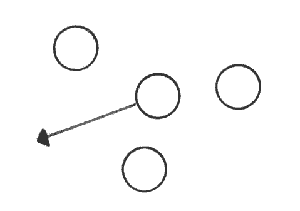
If, however, when you move to get outside and the opponents react by retreating to keep you enclosed, you still have a modest victory. You have still stretched their formation and created room to your backside, if only for a moment.
Now you will most often have only two people near you. You can then move towards one of them. This may be a half step or several. The idea is to isolate one attacker by moving into him. You also and create a little space or time between you and the second. You have begun to dictate the terms.

Here, however, you want to do something more. You want to get to the other side of the attacker you are approaching, so he becomes a physical barrier. Thus, you combine two of the movement patterns discussed in the last segment: the “quick advance” and the “slide or angle past.” If the two attackers were at any distance, you would approach one very quickly using the striding steps discussed in the last segment. (1) If you are close you can also pivot around an attacker, something helpful if the attacker’s blows are beginning to land.
There are three advantages gained by moving to the side or behind and opponent in this situation. First it sets you up to throw, push or so control the attacker (see “Use Your New Friends” in Part 2), to the ground, out of the way or to be used as a barrier or a weapon. Secondly, even if you are still trading techniques with this attacker you can maneuver from side to side or circle to keep him between you and another (a moving barrier) opponent. Finally, you avoid exposing your back to another assailant who might quickly move in on you.
In these situations advantage is only momentary. Other attackers may be moving in fast. So, you want to deal with or control attackers quickly, and I mean very quickly. If you just dance around eventually someone will get to you. Also keep 360 degree awareness. If others are approaching it may be time to zig zag, change direction, pivot and be unpredictable. If the formation is back to three around you again, you may just have to start over.
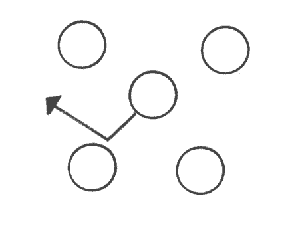
If surrounded by four or more attackers, getting outside their ring is a little more difficult. So, you have to be a little more creative. Again, here we are assuming you have a little room and not in an enclosed area.
One tactic is initially to move into one of the attackers. This creates a little space at your backside from others across the ring, and from the next closest to you on the outside. If you can overcome him with your initial assault, great, but don’t linger. At minimum advance and attack (zig) and then change direction (zag) into an available gap in the ring to get outside. When you are close to one person you can also pivot to the outside. Again you are back to the first illustration of handling two men at a time. The others are too far away for the moment to get to you.
2 – The Wall
In this scenario multiple attackers (here three) are lined up in front of you or walking towards you. The formation resembles a wall.
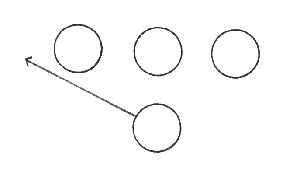
Odds three to one aren’t bad at the track, but in the street if you lose it’s not your paycheck. Again, the movement strategy is to move to the outside. Outflank them. It’s like an end run in football, but it’s you alone and you don’t have blockers. So get to the outside fast. Usually one long and fast step or several quick steps will do it. In the process you might have to do a quick offensive move against one or more attackers, but we will leave this subject for a little later in the article. We want to concentrate first on movement.
When you get to the outside, pivot to face the closest attacker. You have again taken positional advantage. Your opponents are lined up, the man on the outside is in front of the man in the middle, who is in front of the person at the far end. And if they aren’t blocking each other, at least they are all not on top of you — you have dispersed the troops. You can now concentrate on the closest one. If they are standing very close to each other, the bump and run is very effective (discussed in the last segment). This entails pushing, striking or kicking the closest opponent backward into the others standing close behind. They begin tripping and become unbalanced — a little more time.
If in a hallway, when you move past attackers on one side, both the walls and the attacker’s bodies can restrict movement of other attackers. If in a stairwell, positioning yourself on a higher stair gives you positional advantage. Room for movement is limited and from above kicks can here be especially useful, if your legs are not caught and pulled out from under you. (2)
3 – The Loose Half Circle
In this example three attackers have closed around you in a half circle, but are not crowding you. There is one at your front and one at each side. They could be just threatening you, or starting to take action.
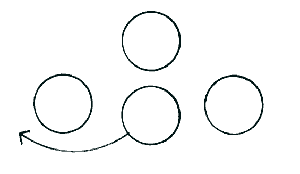
If someone attacks, or course, you have lost the initiative. But there are times when you just don’t know you are going to be attacked. Thus it is always important to maintain a state of heightened awareness when others are around because if you don’t see an attack coming you could be finished.
If an attack starts, your first reaction is to react, But, while you are jamming, blocking or otherwise defending, don’t forget to move. You might also just move to avoid the attack altogether. If you just stand there, other attacks will probably come from the side or behind. A favorite tactic of gang attacks is to have one person hit, grab or otherwise occupy you while the others jump on like a rabid wolf pack.
The best idea is to take the initiative, attacking while moving too. Similar to the wall example above, here too you want to get to the outside — around an attacker on the outside, or through him if you have to. Again, by moving to the side you are creating a momentary space to your back.
The other attackers can no longer get to you, and just like “The Wall” example use above, you have outflanked their formation and taken a positional advantage. The attackers are spread out, lined up and you are on the far end. By the time others can move to the side and forward to engage you, hopefully you have already dealt the attacker nearest you and moved again.
You might use the attacker on the end as a barrier or shield while moving toward the third. Again, you are back to dealing with a two person situation.
If there is a wall behind you things are more difficult. You might fake a move in one direction and then move in the other — a mini zig zag. Just moving quickly toward someone and attacking can create a reaction, such as a defensive shift, or flinch (freezing his movement) you can use to get to the outside.
If an opponent attacks, he is becomes momentarily unbalanced. Deal with the attack but also move past or if the space is tight, slip and slide — that is, get one foot and leg between him and the wall and slide past him using your forward arm against his shoulder to propel you past (also discussed in the last section).
A Note On Attacking
When moving toward someone don’t hesitate between techniques, waist time, or stop your movement. Try to do two or three things at once. Don’t block then counter. Do both together. Don’t kick in such a way as you have to recover your balance before you can punch. Combine them. Combine movement with a fast flurry of techniques that bridges all the ranges of distance to, or past, your opponent.
If your opponent is beyond your reach of your hands or feet you may use an improvised weapon (chair, barstool, brief case, umbrella, etc.) if you have one, or throw something. From this distance you can also attack your opponent’s punches or kicks.
Moving closer your opponent is in range of a fast low kick, or kicks, combined with punches or fast open hand techniques to the eyes, neck or groin.
Still closer these techniques can progress into elbows, knees, leg sweeps, trips and shin kicks.
Finally (if you have not moved to the side) you can head butt, foot stomp, use a hand attack to the groin, or use your hip and/or shoulder to bump, or push — a never ending series of technique that come so fast that it overpowers the attacker.
If you have moved to the side of the opponent you can spin, throw, trip, take down, unbalance or control him, or just continue your attack from this position of advantage.
Once practiced you should be able to execute 10-12 of these techniques in less than two seconds — about all the time you have in many situations.
Here knowledge of vital points and the body’s natural reflexive responses to pain are helpful.
Additional scenarios will be discussed in Part 5 of this series.
Footnotes:
(1) The Pinans also illustrate breaking out of a circle of attackers by using a quick step, or a straight multi-step movement patterns, such as found in the middle of Pinan #1 (three quick steps) which in the above example is used to move between attackers (3 man scenario). Pinan #3 illustrates another pattern — a step and pivot plus another step which is similar to moving into a person, then pivoting around him. This is one option to use in the example of being faced with four or more attackers. Of course, in Pinan #3, a knife hand trust turns into a 360 degree pivot ending up in a horse stance with a strike with the side of the fist. Then there is a step forward with a punch. But, here we are examining movement patterns only, not techniques.
In both of these pinans after a short sequence of several steps the forward movement in the kata stops and changes direction to the side — just as if you broke through a ring of defenders and then moved toward one of them, only to turn the opposite way to move toward another attacker.
It is as if after defeating one attacker you turn and move to the next in the other direction. In each pinan the pattern then moves back towards the starting point, just as if the defender (having defeated the attackers on one side of the circle) is moving to confront those elsewhere (the ones originally moved away from).
(2) Both “The Wall,” and “The Loose Half Circle” scenarios discussed draw on strategies of movement found in Pinan #1. In each, the defender’s first move is to the left, just like in the scenarios above. But, you can also attack the person in front of you as part of your movement to the left.
Many techniques could be used for this frontal attack. It would be quickest, however, if the technique was a quick and natural extension of whatever technique was extended to the left with the step taken in that direction. In Pinan #1 this is a left lower block.
It is within this initial movement that the front strike appears. What looks like the preparation for a downward block disguises the technique. Either hand can be used for the attack, but combined they are very powerful. Below, each hand is discussed separately.
First we will address just the right arm which is held straight and down as part of the preparatory movement to execute a left down block. Three possible applications are discussed.
If your attacker is standing very close (nose to nose), the back of your hand (your right arm is down at your side and you are standing in a natural stance) can be used to slap into the attacker’s testicles (if male). Here the fingers are used and the wrist kept loose (a whipping slap, not a hit). Patrick McCarthy, the well known karate writer and historian, once demonstrated this to me, saying it was a favorite “in and close” technique of many of the old Okinawan Karate masters.
Still talking about the right arm in what looks like preparation for a down block, a more forceful approach could be a short punch into the lower abdomen or right hip of the person in front.
Another variation, and one Mas Oyama used to demonstrate quite effectively on me, was to keep the right arm straight and swing it forward with the hips behind it. This way the arm would be used like a club, the fist striking into any low target directly in front.
Any of these techniques using the right arm will work over several ranges, from very close to almost arms length — to stun the opponent and cause pain. Most likely the opponents head and chest will move forward too — a reflexive reaction to the blow.
Next, we will discuss the use of the left arm that is positioned in preparation for a left down block. The left hand starts at the side of the body. The path used to bring it upward across the body (as part of the block preparation) also can be used to attack a person in front. Since the upper chest and head of the opponent is also moving towards your technique, it impact will be amplified.
If the head is close, the bent elbow of the block can be used to strike the face or head. If the head is a little more distant the rising arm can turn into a rising hook-like strike into the chin, side of the face or neck. If the distance to the head is even further away, the palm of the rising arm (the elbow is less bent) can hit the side of the face or chin, or the fingers can be extended further still into the eye of an opponent as a finger jab or splashing hands.
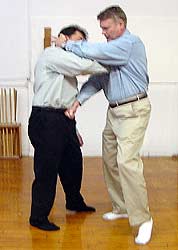 Shown here is one combination of options using both hand together — a right short punch with the right hand into the opponent’s right hip combined with an upper left open hand strike into the side of the opponent’s head.
Whatever the initial attack is to the front (if there is one) the defender then continues to move to the side. In an actual confrontation the hand/arm or kicking technique would be tailored to the attack or defense used. Here, however, we are talking about movement pattern, and the pattern seen in Pinan #1 would be used. Thus a long step is used (front leaning stance) followed by another and then a 180 degree turn. The steps move you into one opponent and away from another, thus creating space at your back, just like in the scenarios.
In the kata the turn is usually seen as little more than a change of direction to face another attacker. But the turn can also be used to use the body of the first attacker (spun, pushed, tripped or thrown) to stop or interrupt another attacker while you deal with a third.
In this way the many turns, pivots and change in directions found in the pinan and other kata can also be understood to have other important uses. Those who have studied the throwing, jujutsu or similar arts, Japanese or Chinese, often see applications jump out at them when they study karate kata. This makes sense, since karate developed on Okinawa as an amalgam of Chinese and indigenous fighting arts with perhaps some Japanese influence.
Part 1: Interfering With And Avoiding An Impending Attack
Part 2: Principles & Tactics
Part 3: Maneuvering For Advantage: Basics
Part 4: Maneuvering For Advantage: Putting it all together
Part 5:Maneuvering For Advantage: More Scenarios

About the Author Christopher Caile

Screenshot
Christopher Caile is the Founder and Editor-In-Chief of FightingArts.com. He has been a student of the martial arts for over 65 years.
He first started in judo while in college. Then he added karate as a student of Phil Koeppel in 1959 studying Kempo and Wado-Ryu karate. He later added Shotokan Karate where he was promoted to brown belt and taught beginner classes. In 1960 while living in Finland, Caile introduced karate to that country and placed fourth in that nation’s first national judo tournament.
Wanting to further his karate studies, Caile then hitch hiked from Finland to Japan traveling through Scandinavia, Europe, North Africa, the Middle East and South and Southeast Asia — living on 25 cents a day and often sleeping outside.
Arriving in Japan (1962), Caile was introduced to Mas Oyama and his fledgling full contact Kyokushinkai Karate by Donn Draeger, the famous martial artist and historian. Donn also housed him with several other senior international judo practitioners. Donn became Caile’s martial arts mentor, coaching him in judo and introducing him to Shinto Muso-ryu under Takaji Shimizu.
Caile studied at Oyama’s honbu dojo and also at Kenji Kurosaki’s second Tokyo Kyokushinkai dojo. In his first day in class Oyama asked Caile to teach English to his chief instructor, Tadashi Nakamura. They have been friends ever since. Caile also participated in Oyama’s masterwork book, “This Is Karate.”
Caile left Japan with his black belt and designation as Branch Chief, the first in the US to have had extensive training in Japan directly under Oyama Sensei. As such, Oyama Sensei asked him to be his representative on visits to his US dojos to report on their status.
A little over a year later, Nakamura, Kusosaki and Akio Fujihira won an epic David vs. Goliath challenge match against Thailand’s professional Muay Thai Boxers in Bangkok, Thailand, thrusting Kyolushinkai and Nakamura into national prominence.
Back in the US Caile taught Kyokushinkai karate in Peoria, Il while in college and later in Washington, DC. while in graduate school. Durimg this time Shihan Nakamura had moved to New York City to head Kyokushinkai’s North American Operation.
In 1976 when Kaicho Tadashi Nakamura formed the World Seido Karate organization, Caile followed. Living then in Buffalo, NY, Caile taught Seido karate and self-defense at the State University of New York at Buffalo (SUNY Buffalo) for over 15 years where he also frequently lectured on martial arts and Zen in courses on Japanese culture.
Caile moved to New York City in 1999 to marry Jackie Veit. He is now an 8th degree black belt, Hanshi, training in Seido Karate’s Westchester, NY Johshin Honzan (Spiritual Center) dojo. In Seido Caile is known for his teaching of and seminars on kata applications. He also produced a 14 segment video series on Pinan kata Bunkai currently available to Seido members.
Caile is also a long-time student and Shihan in Aikido. He studied in Buffalo, under Mike Hawley Shihan, and then under Wadokai Aikido’s founder, the late Roy Suenaka (uchi deshi under Morihei Ueshiba, founder of Aikido and was Shihan under Tohei Sensei). In karate, Suenaka (8thdan) was also an in-house student of the Okinawan karate master Hohan Soken.
Having moved to New York City, Caile in 2000 founded this martial arts educational website, FightingArts.com. Twenty-five years later, in 2025, it underwent a major update and revision.
For FightingArts.com and other publications Caile wrote hundreds of articles on karate, martial arts, Japanese art, Chinese Medicine and edited a book on Zen. He also developed relationships with a cross section of leading martial arts teachers. Over the last four decades he has conducted extensive private research into karate and martial arts including private translations of the once secret Okinawan hand copied and passed on Kung Fu book, the Bubishi, as well as an early karate book by the karate master Kenwa Mabuni. He periodically returns to Japan and Okinawa to continue his studies and participate Seido karate events. In Tokyo he practiced (with Roy Suenaka Sensei) in a variety of aikido organizations with their founders – including private interviews and practices at the Aiki-kai Aikido Honbu dojo with the son and grandson of aikido’s founder, Doshu (headmaster) Kisshomaru (an old uchi-deshi friend) and his son, Moriteru Ueshiba and in Iwama with Morihiro Saito. On Okinawa he studied Goju Ryu karate under Eiichi Miyazato, 10th dan founder of Naha’s Jundokan, and also with Yoshitaka Taira (who later formed his own organization, who specialized in kata Bunkai. While there Caile also trained with Hohan Soken’s senior student, Master Fusei Kise, 10 dan as well as with the grandson of the legendary karate master Anko Itosu.
Caile’s other martial arts experience includes: Diato-ryu Aikijujitsu and Kenjitsu, kobudo, boxing, Muay Thai, MMA, Kali (empty hand, knife and bolo), study of old Okinawan Shoran-ryu & Tomari body mechanics, study of old Okinawan kata under Richard Kim, study of close quarter defense and combat, including knife and gun defenses, Kyusho Jitsu and several Chinese fighting arts including 8 Star Praying Mantis, Pak Mei (White Eyebrow), and a private family system of Kung Fu.
Caile is also a student of Zen as well as a long-term student of one branch of Traditional Chinese Medicine, Chi Kung (Qigong). As one of two senior disciples of Chi Kung master Dr. Shen (M.D., Ph.D.) Caile was certified to teach and practice. This led to Caile’s founding of the The Chi Kung Healing Institute on Grand Island, NY. In Western NY, he also frequently held Chi Kung seminars, including at SUNY Buffalo and at the famous Chautauqua Institution in Chautauqua, NY. His articles on Chi Kung also appeared in the Holistic Health Journal and in several books on alternative medicine.
Caile holds a BA in International Studies from Bradley University and MA in International Relations with a specialty in South and Southeast Asia from American University in Washington, D.C. While in Buffalo, NY he also studied digital and analog electronics.
In his professional life Caile also worked in public relations and as a newspaper reporter and photographer. Earlier he worked in the field of telecommunications including Managing a Buffalo, NY sales and service branch for ITT. He then founded his own private telephone company. This was followed by creation of an electrical engineering company that designed and patented his concept for a new type of low-cost small business telephone system (which was eventually sold to Bell South). The company also did contract work for Kodak and the US space program. Simultaneously Caile designed and manufactured a unique break-apart portable pontoon boat.
Most recently Caile co-founded an internet software company. Its products include software suites with AI capability for control and management of streaming media, such as video and music, an all-in-one book publishing software product for hardcover, eBook and audio book creation and security software for buildings and government use.
For more details about Christopher Caile’s martial arts, work experience and life profile, see the About section in the footer of this site.
Search for more articles by this author: