
The Double Lapel Grab
By Christopher Caile
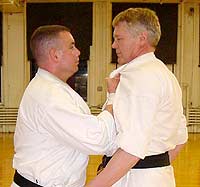
It is a common attack. An aggressor grabs you — both of his or her hands pull in your jacket lapels (or both sides of your shirt). You end up eyeball to eyeball with emotion — often accompanied with a vent of expletives or threats mixed with a spray of spit.
It’s scary, perhaps, but the attack is faulty since both hands are occupied and you are too close to kick easily. The defender, however, has a free hand, elbow, head, two knees and feet available as weapons.
Of course, watch out for a low knee or a head butt, but often this attack is one of anger or frustration without the intent to harm, or at least indecision as to what exactly to do next. So, with this attack you have a lot of options.
Throughout this series on basic self-defense techniques I have stressed two basic principles. First, there should be a “continuum of force” in any self-defense application — starting with techniques which may hurt, sting or create the release itself, but that will do no harm to the aggressor, and progressing through to being able to render the assailant unconscious, incapacitated or immobilized.
The second critical factor is that any technique should be effective, easily applied and useful for a weaker person against a stronger one. (1)
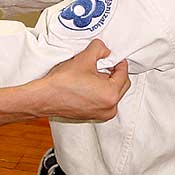 If the grab is non-threatening or some playful episode, the defender can usually get the attacker to let go with any number of simple but painful, or other distraction techniques. Two techniques I especially like in this situation is a simple grab and twist of the nose (not shown) and an under arm pinch (shown). See: Ouch! The Mighty Little Pinch For Self-defense.
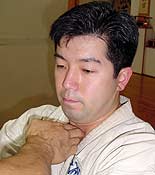
Another useful (but one step up in escalation) technique is a two finger downward thrust into the aggressor’s jugular notch (attacking the trachea and the small nerve fibers in this region) (2) which evokes an involuntary gag reflex away from the pressure. Usually an attacker will let go and just step away. Two fingers supported by the thumb is fairly strong but also small enough to access the “V” at the base of the neck. The technique starts directly in but then turns down. The technique should also be done quickly.

Progressive Techniques
If the double lapel attack is not progressing beyond an additional verbal assault, the defender has the preferable option of trying to defuse the situation with rhetoric. But there are times when this just won’t work. Perhaps the grab has been accompanied by a knee, or a second aggressor is waiting to attack. When it is evident that you must fight back, my favorite self-defense technique comes right out of the karate Kata Pinan (Heian) number four. These techniques are designed to be done in a quick, powerful sequence, but the sequence can be ended at any time. Be careful if you practice it, and do so only under supervision of a trained expert in pressure points and resuscitation.
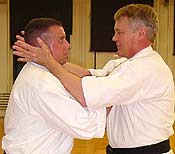 As the attacker is pulling you inward, you do a double hand technique to the aggressor’s head (both sides). This can be preceded with a loud shout (kiai) just before you strike that will startle, and thus momentarily freeze any reaction.
There are several target options (3), including the temples. Here I strike with the base of my hands (shotei) inward and pulling slightly back toward myself to the edge of the jaw right below the ears, sometimes known as the mandibular angle point. The strike affects three major nerves which run together behind the jaw bone under the ear. (4) This move will stun or knock out the opponent. Be careful with this strike. You do not have to hit hard.
 Immediately drop your hands to the back of the opponent’s shoulders and pull them (rolling them forward and down using your body weight) toward yourself. Be careful here not to inadvertently pull your opponent’s head into your face (unless your are doing an offensive head butt. See footnote 3). As your opponent’s trunk moves downward thrust upward (using your hips) with a rear knee kick (when you were pulled forward one leg usually naturally moves forward to retain balance). The ideal target is the opponent’s solar plexus or other abdominal target. (5) A natural extension of the hard upper knee action (not shown here) is to follow with a instep kick to the groin. (6)
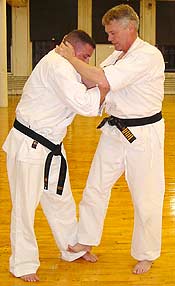 As in the kata (pinan four) the kicking leg is then trust downward (while you still have your hands on the opponent’s shoulders). The side of your foot near the heel (knife foot or sokuto) is turned sidewise so the side of the foot hits downward into the arch or the area of the foot above the toes (metatarsals). (7) Notice that your techniques so far have followed a pattern, high, middle and low in quick succession. Now you go back to high.
 At this point move (your hands still on the opponent’s shoulders) your left palm upward to strike the side of the opponent’s head with the palm and wrist. This move will hold the head while your right elbow strikes into the opponent’s jaw from the other direction. The head will twist to the side. The twisting of the body to perform the right elbow strike should also be transmitted downward into a turn of the right heel (with weight) just after it has struck downward into the opponent’s foot. The twist itself is capable of causing additional pain or even unconsciousness if the right area is targeted (see footnote # 7) since it can spread the long bones of the foot.
At this point you are turning to face the opposite direction, as in the kata. Here there is an option. The defender can let go of the attacker’s head and execute (as seen in pinan four) a double knife hand block (the position of the hands on the head are the same as when cocking the arms to execute this block). But, the defender can also hold on to the attacker’s head and execute a throw. But this is a very dangerous technique and is not discussed in the body of this article. (8) You do not want to cause permanent injury.
Not all these techniques are probably necessary. Hopefully non-harmful releases will work. And if you have be more aggressive, most often the first strike into the temples or area behind the ears will end any further hostilities. But additional techniques are included in case they are needed. The aim of the side of the head strikes may have been faulty or the attacker might have been unusually impervious to pain. Thus a quick succession of techniques have been included to be used if necessary.
Footnotes:
(1) See my Opinion piece: The Disservice Of Bad Techniques.
(2) The nerves affected are the superior laryngeal and the recurrent laryngeal.
(3) Several of the options include a double forward shuto strike (little finger side of the hand) or double palm heel strike into the sides of the attacker’s neck as an attack to the carotid sinuses (which help regulate blood pressure). This can cause a fast drop in blood pressure and stun the opponent or cause momentary unconsciousness. Be very careful with this type technique, however, it is dangerous. If you practice this pressure point technique, hit very gently, and only when under supervision of an expert trained in pressure point techniques and resuscitation. Another variation of this technique uses the fingers of the hand as guides (on the outside of the neck) to guide the thumbs into the same target. The technique looks like an upward double knife hand technique. An especially powerful variation of this technique is described below. This is explained only for educational purposes (kata bunkai) since it is a dangerous technique not to be practiced. As the aggressor pulls you inward, strike with your knee upward to the inside of the attacker’s leg (the groin in a second option) just above the knee (if the attacker has pulled you in close) which will break his balance (the knee momentarily losing its power or collapsing) as you strike upward into the side of the neck. This is immediately followed by your own forehead head butt into the attacker’s nose. This variation can be incorporated into the sequence of techniques explained above, but should be avoided due to the danger of the technique. It is included here for those interested in possible kata applications.
(4) The nerves are the hypoglossal, vagus and glossopharyngeal. The angle of attack should be into and under the rear edge of the jaw bone under the earlobe into the head, but slightly backward toward the nose. Be careful not to forcefully pull back toward yourself with this strike since it can cause detachment of the jaw. This is one of the most reliable pressure points on the body, and it will cause intense pain or unconsciousness if struck with even moderate power. This does not have to be a hard strike. Practice using one knuckle of the hand lightly striking a partner who will allow you to test this technique. In French Savate and some kung fu systems, a cupped hand is used to strike this area.
(5) Often variations of the two opponent’s heights, how far you have been pulled in and/or how far you have pulled the opponent’s shoulders and trunk into your knee will actually determine the target. The solar plexus is ideal, but the lower abdomen (below the belly button), the groin or even the inside of the leg above the knee are also adequate. This is a powerful technique since you are pulling the opponent into your thrusting knee counter-attack.
(6) This secondary groin kick is not overtly practiced in the kata pinan four, but has been shown to me as a hidden technique.
(7) The metatarsals (also found in the hands) are the long bones that connect ankle and small bones in front of it with the bones of each toe. The ideal target is to hit with the heel area of the side of the foot into the area between the metatarsal bone of the small toe and the fourth toe (about two inches above the web of the junction of the small and fourth toe). With the weight still bearing down on this point, even a small twist of the foot (heel) separates the two bones (the toe metatarsal bone is weak and unsupported by other bones on one side) and will cause great pain and possibly unconsciousness. During one demonstration of this technique several years ago, I stepped lightly with my heel on this point and then turned slightly to address the audience. Immediately I felt something and heard a thud. I looked back to see my partner on the floor –out cold. This is an example of causing a neurological overload – an intense burst of nerve feedback that overloads the brain and causes a short shut down, or black out. The student didn’t remember anything after feeling a sharp pain in the area of his foot as I turned.
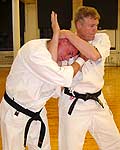
(8) For those who are students of the applications or bunkai found in kata, consider the following. This follow-up throwing technique is not to be practiced since it starts with a twisted neck. The movement leverages this position into a takedown or throw that employs increased twisting action on an already stressed neck. This could cause permanent spinal injury or even death. Never attempt this technique. If the elbow strike movement is continued, while the left hand still holds the side of the attacker’s head, the right forearm has moved under the opponent’s jaw and now reaches upward (the crook of the elbow under the jaw). Using both arms the opponent is now easily pulled forward in a throw-like action. This not only downs the opponent, but the opponent’s body can be used as a barrier to be maneuvered, or thrown to the ground to trip a rapidly advancing second opponent. Interestingly, virtually the same movement used in a two hand shuto block can here also be used to trap a head and execute a throw. It should be noted, however, that this is not a throw to be attempted against an unwilling opponent. Instead it is a finishing technique to be used against someone who is already stunned or otherwise incapacitated.

About the Author Christopher Caile
Screenshot
Christopher Caile is the Founder and Editor-In-Chief of FightingArts.com. He has been a student of the martial arts for over 65 years.
He first started in judo while in college. Then he added karate as a student of Phil Koeppel in 1959 studying Kempo and Wado-Ryu karate. He later added Shotokan Karate where he was promoted to brown belt and taught beginner classes. In 1960 while living in Finland, Caile introduced karate to that country and placed fourth in that nation’s first national judo tournament.
Wanting to further his karate studies, Caile then hitch hiked from Finland to Japan traveling through Scandinavia, Europe, North Africa, the Middle East and South and Southeast Asia — living on 25 cents a day and often sleeping outside.
Arriving in Japan (1962), Caile was introduced to Mas Oyama and his fledgling full contact Kyokushinkai Karate by Donn Draeger, the famous martial artist and historian. Donn also housed him with several other senior international judo practitioners. Donn became Caile’s martial arts mentor, coaching him in judo and introducing him to Shinto Muso-ryu under Takaji Shimizu.
Caile studied at Oyama’s honbu dojo and also at Kenji Kurosaki’s second Tokyo Kyokushinkai dojo. In his first day in class Oyama asked Caile to teach English to his chief instructor, Tadashi Nakamura. They have been friends ever since. Caile also participated in Oyama’s masterwork book, “This Is Karate.”
Caile left Japan with his black belt and designation as Branch Chief, the first in the US to have had extensive training in Japan directly under Oyama Sensei. As such, Oyama Sensei asked him to be his representative on visits to his US dojos to report on their status.
A little over a year later, Nakamura, Kusosaki and Akio Fujihira won an epic David vs. Goliath challenge match against Thailand’s professional Muay Thai Boxers in Bangkok, Thailand, thrusting Kyolushinkai and Nakamura into national prominence.
Back in the US Caile taught Kyokushinkai karate in Peoria, Il while in college and later in Washington, DC. while in graduate school. Durimg this time Shihan Nakamura had moved to New York City to head Kyokushinkai’s North American Operation.
In 1976 when Kaicho Tadashi Nakamura formed the World Seido Karate organization, Caile followed. Living then in Buffalo, NY, Caile taught Seido karate and self-defense at the State University of New York at Buffalo (SUNY Buffalo) for over 15 years where he also frequently lectured on martial arts and Zen in courses on Japanese culture.
Caile moved to New York City in 1999 to marry Jackie Veit. He is now an 8th degree black belt, Hanshi, training in Seido Karate’s Westchester, NY Johshin Honzan (Spiritual Center) dojo. In Seido Caile is known for his teaching of and seminars on kata applications. He also produced a 14 segment video series on Pinan kata Bunkai currently available to Seido members.
Caile is also a long-time student and Shihan in Aikido. He studied in Buffalo, under Mike Hawley Shihan, and then under Wadokai Aikido’s founder, the late Roy Suenaka (uchi deshi under Morihei Ueshiba, founder of Aikido and was Shihan under Tohei Sensei). In karate, Suenaka (8thdan) was also an in-house student of the Okinawan karate master Hohan Soken.
Having moved to New York City, Caile in 2000 founded this martial arts educational website, FightingArts.com. Twenty-five years later, in 2025, it underwent a major update and revision.
For FightingArts.com and other publications Caile wrote hundreds of articles on karate, martial arts, Japanese art, Chinese Medicine and edited a book on Zen. He also developed relationships with a cross section of leading martial arts teachers. Over the last four decades he has conducted extensive private research into karate and martial arts including private translations of the once secret Okinawan hand copied and passed on Kung Fu book, the Bubishi, as well as an early karate book by the karate master Kenwa Mabuni. He periodically returns to Japan and Okinawa to continue his studies and participate Seido karate events. In Tokyo he practiced (with Roy Suenaka Sensei) in a variety of aikido organizations with their founders – including private interviews and practices at the Aiki-kai Aikido Honbu dojo with the son and grandson of aikido’s founder, Doshu (headmaster) Kisshomaru (an old uchi-deshi friend) and his son, Moriteru Ueshiba and in Iwama with Morihiro Saito. On Okinawa he studied Goju Ryu karate under Eiichi Miyazato, 10th dan founder of Naha’s Jundokan, and also with Yoshitaka Taira (who later formed his own organization, who specialized in kata Bunkai. While there Caile also trained with Hohan Soken’s senior student, Master Fusei Kise, 10 dan as well as with the grandson of the legendary karate master Anko Itosu.
Caile’s other martial arts experience includes: Diato-ryu Aikijujitsu and Kenjitsu, kobudo, boxing, Muay Thai, MMA, Kali (empty hand, knife and bolo), study of old Okinawan Shoran-ryu & Tomari body mechanics, study of old Okinawan kata under Richard Kim, study of close quarter defense and combat, including knife and gun defenses, Kyusho Jitsu and several Chinese fighting arts including 8 Star Praying Mantis, Pak Mei (White Eyebrow), and a private family system of Kung Fu.
Caile is also a student of Zen as well as a long-term student of one branch of Traditional Chinese Medicine, Chi Kung (Qigong). As one of two senior disciples of Chi Kung master Dr. Shen (M.D., Ph.D.) Caile was certified to teach and practice. This led to Caile’s founding of the The Chi Kung Healing Institute on Grand Island, NY. In Western NY, he also frequently held Chi Kung seminars, including at SUNY Buffalo and at the famous Chautauqua Institution in Chautauqua, NY. His articles on Chi Kung also appeared in the Holistic Health Journal and in several books on alternative medicine.
Caile holds a BA in International Studies from Bradley University and MA in International Relations with a specialty in South and Southeast Asia from American University in Washington, D.C. While in Buffalo, NY he also studied digital and analog electronics.
In his professional life Caile also worked in public relations and as a newspaper reporter and photographer. Earlier he worked in the field of telecommunications including Managing a Buffalo, NY sales and service branch for ITT. He then founded his own private telephone company. This was followed by creation of an electrical engineering company that designed and patented his concept for a new type of low-cost small business telephone system (which was eventually sold to Bell South). The company also did contract work for Kodak and the US space program. Simultaneously Caile designed and manufactured a unique break-apart portable pontoon boat.
Most recently Caile co-founded an internet software company. Its products include software suites with AI capability for control and management of streaming media, such as video and music, an all-in-one book publishing software product for hardcover, eBook and audio book creation and security software for buildings and government use.
For more details about Christopher Caile’s martial arts, work experience and life profile, see the About section in the footer of this site.
Search for more articles by this author: